


Drive-Over Spill Barrier, Made to Measure
 Contact form
 +31 (0)316-250830
 Buitink Technology
A liquid retaining threshold from Buitink Technology keeps firewater, leaks and spills inside a room or area without blocking the doorway. This flexible drive-over spill barrier (also called a flexible floor bund) has a core of soft foam inside a heavy cover of PVC-coated polyester fabric (PVC = polyvinyl chloride). Forklifts and trucks simply drive over it: the foam compresses and springs straight back.
Every threshold is made to measure for your doorway, gate, loading bay or wash bay: straight, with welded-in corners, or as an L- or U-shape, in one continuous piece up to about 22 metres. You receive it as a kit with an installation manual and fit it yourself onto the existing concrete or asphalt floor.
- Standard height 70 mm; also available in 100 and 150 mm
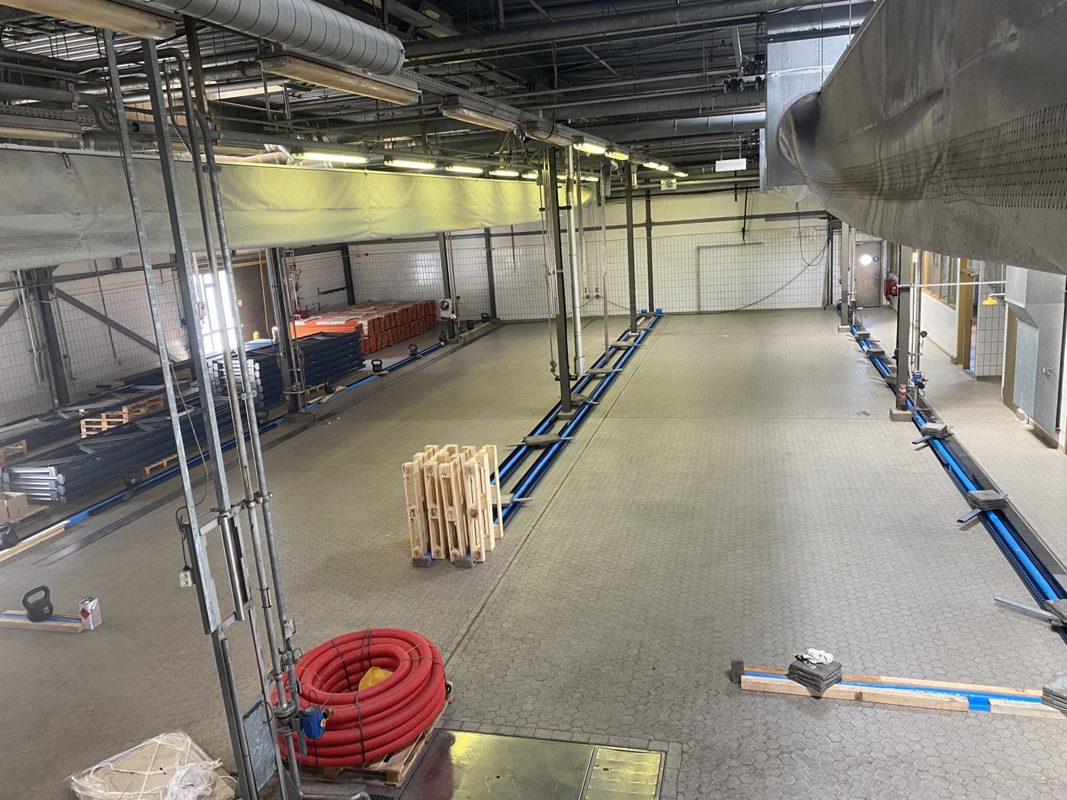
- Driven over by forklifts and trucks; in use on loading bays and in production halls
- Made to measure: straight runs, corners from 45 to 135 degrees, L- and U-shapes, upstand against a wall or kerb
- Delivered in 3 to 4 weeks, including aluminium clamping strip and nail plugs; self-install with locally available construction sealant
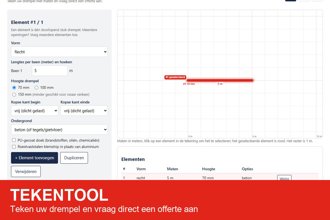
✎ Open the drawing tool: draw your threshold and request a quotation
How does a drive-over spill barrier work?
In an emergency, for example a leaking IBC (Intermediate Bulk Container, a 1,000 litre plastic liquid container), a spill during loading and unloading, or firewater after a fire, the threshold turns the existing floor and walls into a basin. The liquid stays inside the zone and does not run into the sewer, the soil or the adjacent room. This limits environmental damage and cost and helps you meet the requirements that the authorities or your insurer set for product and firewater containment.
The difference from a fixed concrete upstand or a mechanical flap barrier: the passage always stays open. No operation, no sensor, no maintenance contract. The threshold lies there, does nothing until it is needed, and forklifts and trucks drive over it every day.
How much liquid does a threshold retain?
The containment volume is easy to calculate: floor area × threshold height. A hall of 20 × 15 metres with a 70 mm threshold retains 20 × 15 × 0.07 = 21 m³ (21,000 litres). If you need more volume on the same floor area, choose the 100 or 150 mm version. Note: the floor itself must of course be liquid-tight or liquid-retaining; the threshold only closes the openings.
Specifications liquid retaining threshold
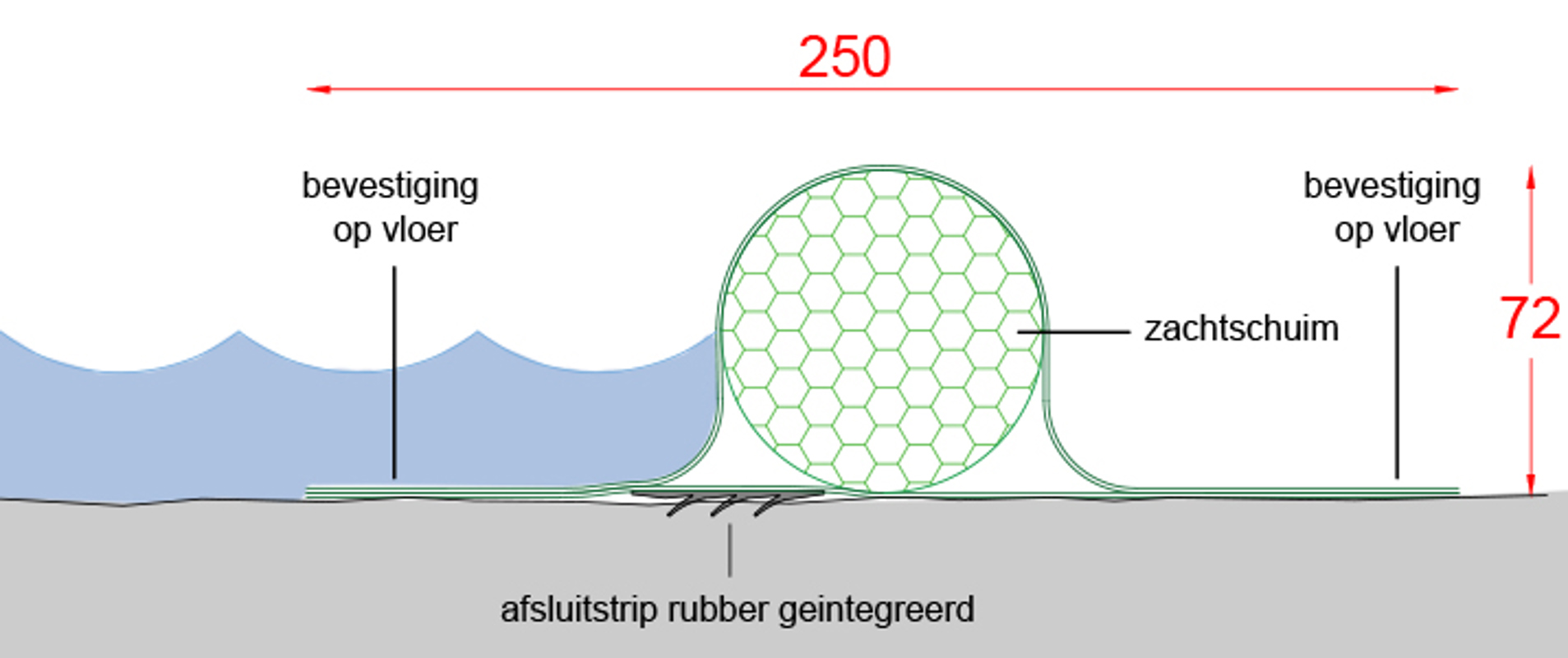
| Installed height | approx. 72 mm (standard); 100 mm and 150 mm also available |
|---|---|
| Core | soft open-cell polyether foam, round, diameter 70 mm (or 100 / 150 mm) |
| Cover | PVC-coated polyester fabric, approx. 1,500 g/m², tensile strength approx. 7,000 N per 5 cm, enhanced tear and puncture resistance |
| Base strip | 250 mm wide, same fabric, high-frequency welded to the cover |
| Seal to the floor | integrated rubber strip under the base, triple-stitched; seals against the floor surface |
| Ends | welded closed; optional 200 mm upstand against a wall or kerb |
| Corners | welded into one continuous piece; 90 degrees standard, 45 to 135 degrees possible; L- and U-shapes |
| Length per element | up to approx. 22 metres in one piece; longer runs from several elements |
| Weight | approx. 1.5 kg per metre |
| Colour | grey (standard) or blue; red-white hazard marking possible |
| Drive-over | yes: forklifts and trucks; the foam springs back. The 150 mm version is less suitable for heavy and frequent traffic. For intensive heavy truck traffic (for example dozens of trucks per day) we give no warranty on wear; test the threshold yourself on one position first |
| Chemical resistance | PVC fabric: good against water, firewater, diluted acids and alkalis, detergents, fertiliser solutions and short-term oil contact. For fuels, oils and solvents: PU-coated fabric (PU = polyurethane), approx. 1,000 g/m², as an option |
| Fixing | construction sealant (MS polymer) under the base strip plus clamping strip 40 × 3 mm with nail plugs. Aluminium clamping strip and nail plugs are included; stainless steel strip as an option; sealant is bought locally |
| Service life | several years in normal use; wear on the wheel track shows on the cover; repair or replacement per element |
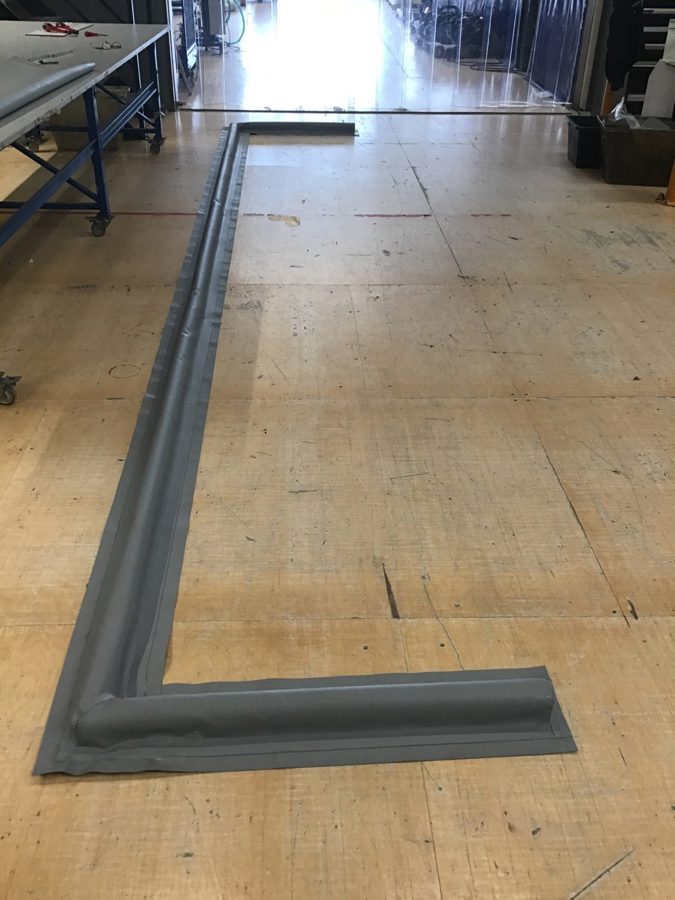
Shapes made to measure: straight, L-shape, U-shape
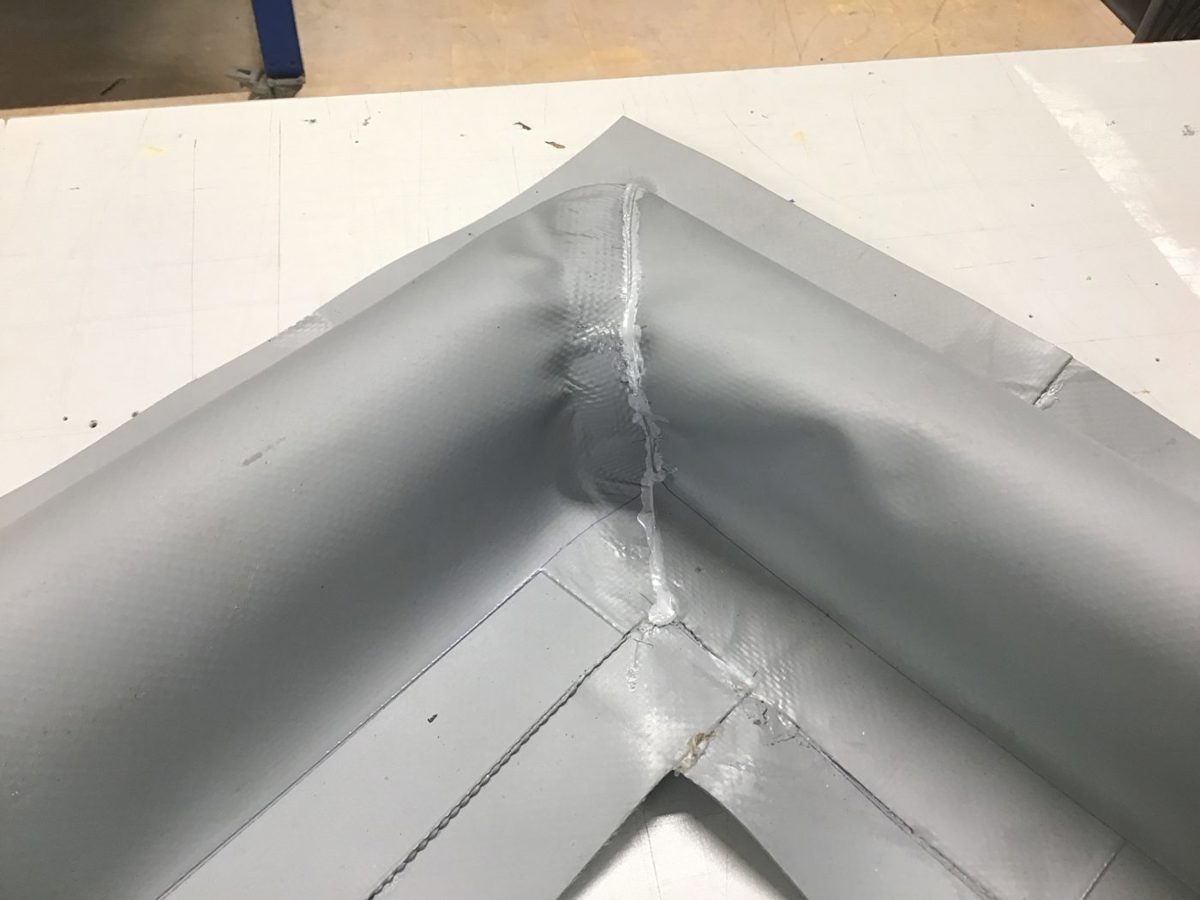
Every threshold is made for your situation. We weld the corners into one continuous piece, so there are no connectors or joints that can leak.
- Straight: for doorways, gates and entrances; up to approx. 22 metres in one piece.
- L-shape: one welded-in corner, for example to close a line along a wall.
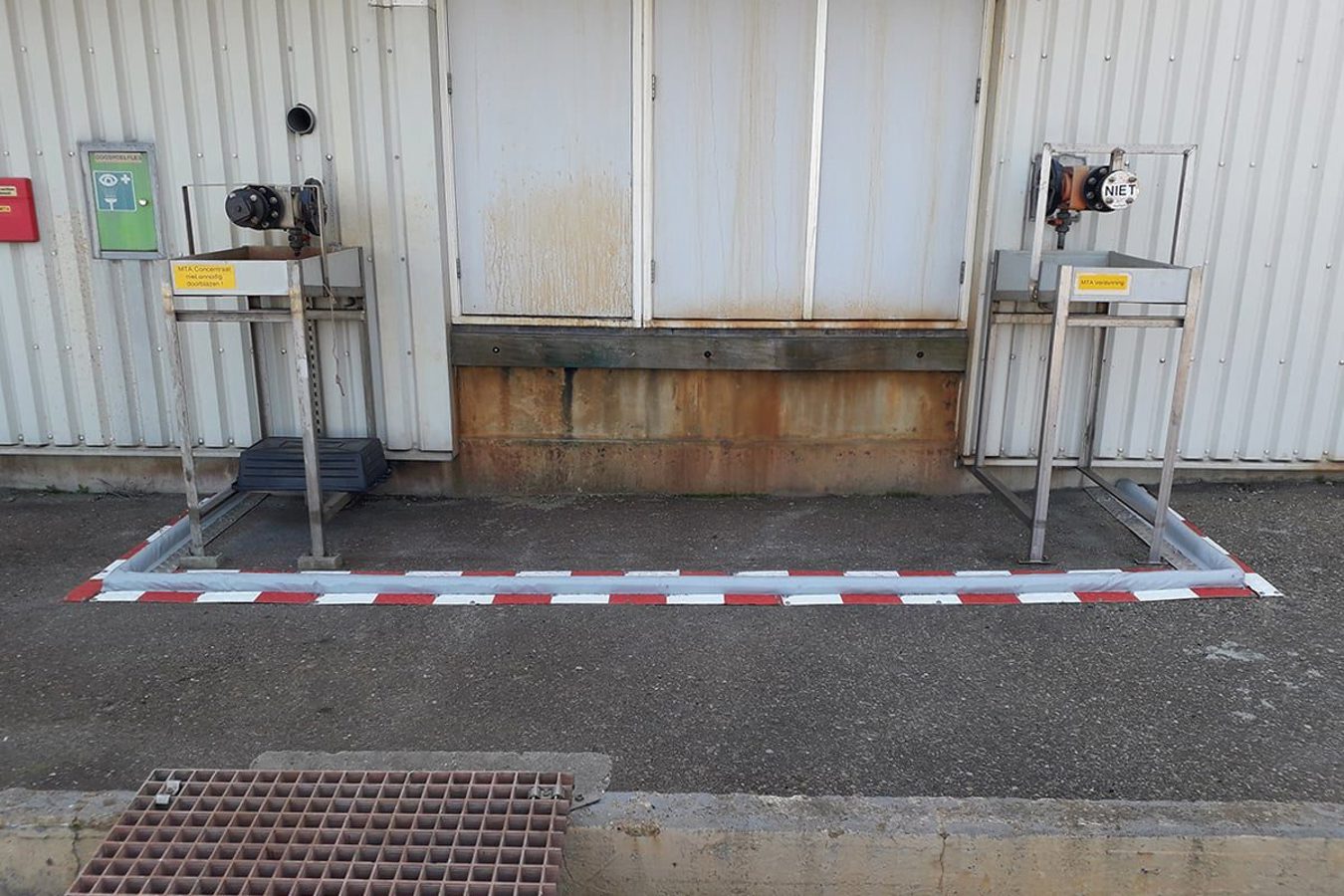
- U-shape: two corners, for example around a filling point, a refuelling area or a machine against the facade.
- Free shape: several corners or a line around a complete installation; for long runs we supply several elements that you fit end to end.
Corners are 90 degrees as standard; 45, 60, 120 and 135 degrees are also possible. Ends are welded closed. Where the threshold meets a wall or kerb, we make the end run 200 mm upwards (upstand) so that you can seal it against the wall and the basin is closed there too.
With your enquiry, give the length of each leg in metres, the corner angles in degrees, the required height, the floor type (concrete or asphalt) and whether the ends are free or meet a wall or kerb. With the online drawing tool you draw the shape yourself and send your request directly.
Made to measure, shipped, self-install: how it works
- You send us the dimensions. Lengths, angles, height, floor type and a photo of the situation. Through the drawing tool, by e-mail or by phone. No site survey needed.
- We confirm the dimensions and the price. You receive a quotation with the exact dimensions. After your order we confirm the dimensions by e-mail.
- We produce in 3 to 4 weeks. Your threshold is high-frequency welded, checked and packed on a pallet or in a long box in our own factory in Duiven, the Netherlands. Shipping throughout Europe.
- You install it yourself. We supply the threshold including aluminium clamping strip and nail plugs, with the installation manual; the construction sealant you buy from a local builders' merchant. Your own maintenance team or contractor fits the threshold in half a day. No fitter, no downtime. Remote installation guidance by video call is available.
Only for large projects do we carry out the installation ourselves. In all other cases self-installation is faster and cheaper, and the manual explains every step.
Installation in brief
The threshold is bonded and clamped to the existing floor. The sealant provides the seal; the clamping strip with anchors provides the fixing under traffic.
- Prepare the floor: clean, dry and free of grease, no loose laitance. Application temperature +5 to +35 °C.
- Apply sealant: two continuous beads of MS polymer (modified silane) construction sealant under the base strip. Consumption: approx. 1 cartridge of 290 ml per 3 metres of threshold.
- Press down and clamp: the supplied aluminium clamping strip 40 × 3 mm on both edges of the base, on concrete with the supplied nail plugs (nylon hammer-fixing plug 6 × 40 mm) every 400 to 500 mm. Sealant does not bond to asphalt; use a longer nail plug (8 × 80 mm) there and the sealant as a seal only. Seal the screw heads.
- Curing: traffic after 24 hours at the earliest; full strength after 2 to 3 days.
We do not supply the sealant, but we advise you which internationally available sealant types and anchors suit your floor. The complete installation manual with consumption table and drilling dimensions is here: installation manual liquid retaining threshold (PDF).
Applications and examples
Liquid retaining thresholds are used wherever a room or yard must act as a basin in an emergency while the passage stays open:
- Doorways and gates of hazardous goods stores and chemical warehouses
- Loading bays, loading pits and tanker entrances
- Wash bays and rinsing areas, also combined with our mobile wash pads
- Refuelling and filling points
- Firewater containment at sprinkler-protected buildings and in production halls
- Around machines, compressors, tanks and temporary production set-ups
- Protection of floor drains against inflowing liquid
Examples from practice
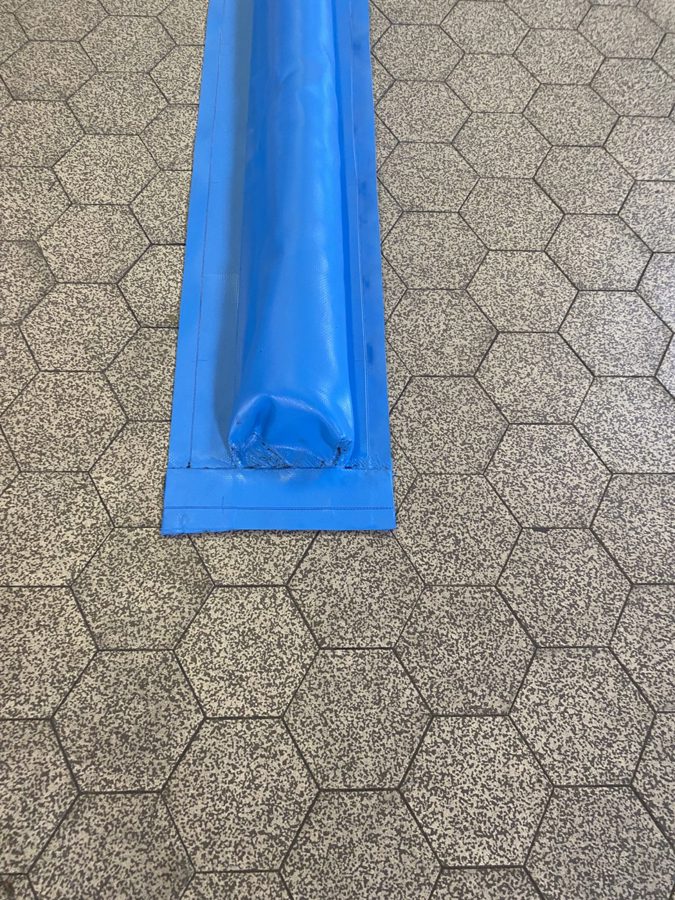
- Flavour and fragrance production hall, the Netherlands (2025): 99 metres of threshold around a temporary production set-up on a tiled floor, including a 200 mm upstand against the wall. Daily forklift traffic; installed with sealant only (temporary indoor set-up).
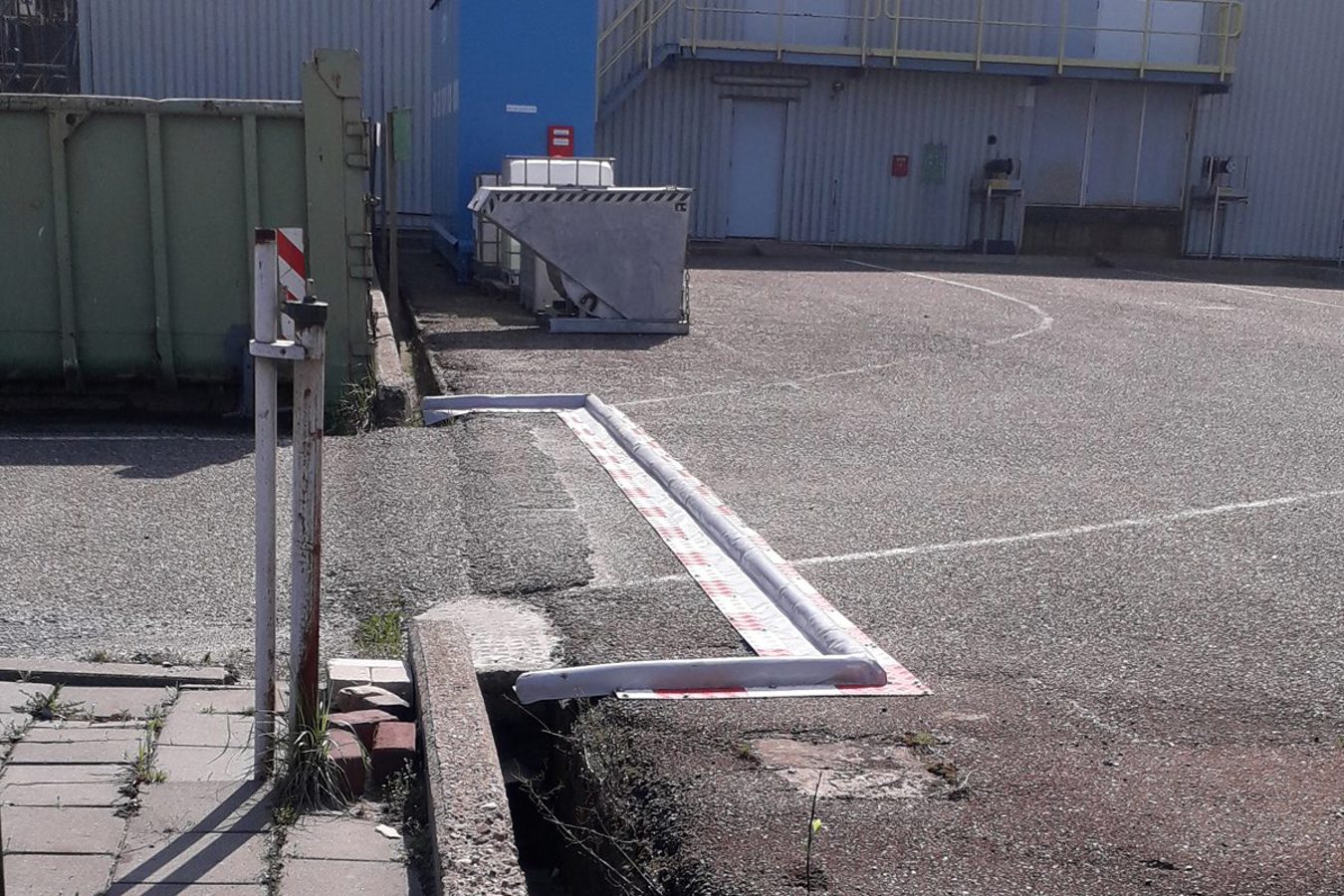
- Chemical park, northern Netherlands (2017 to 2024): U-shapes and straight runs at filling points and at the truck entrance, red-white marked; thresholds at the wash bay. In 2024 a 6.3 metre U-shape with two 90 degree corners, shipped in a wooden crate.
- Hydraulics manufacturer, Germany (2022): short straight element, shipped by parcel post in a box.
Price on request
Every threshold is made to measure. The price depends on the length, the number of corners and upstands, the height and the fabric. Draw your situation in the online drawing tool or send us a sketch with dimensions and you will receive a quotation within two working days. The price includes the aluminium clamping strip and nail plugs; sealant and installation are not included. Delivery time 3 to 4 weeks after order.
Regulations: liquid retaining, firewater containment and soil protection
A liquid retaining threshold is a liquid retaining provision: it holds liquid back temporarily so that you have time to clean up or pump out. Whether a threshold is sufficient in your situation is decided by the competent authority, the fire service or your insurer. The information below is for orientation only and is no guarantee of approval.
- Netherlands: PGS 15 (Publicatiereeks Gevaarlijke Stoffen, the Dutch guideline for storage of packaged hazardous substances) sets requirements for product and firewater containment. The Besluit activiteiten leefomgeving (Bal, the Dutch environmental activities decree) distinguishes liquid-tight and liquid-retaining soil protection provisions. A threshold in a doorway turns a liquid-retaining floor into a closed basin.
- Germany: Wasserhaushaltsgesetz (WHG, federal water act), the Verordnung über Anlagen zum Umgang mit wassergefährdenden Stoffen (AwSV, ordinance on installations handling water-polluting substances), the technical rule TRwS 779 and the Löschwasser-Rückhalte-Richtlinie (LöRüRL, firewater retention guideline).
- Belgium (Flanders): VLAREM II (the Flemish environmental permit regulation), article 4.1.12.1: firewater must not enter the sewer or surface water; the fire service guideline on firewater containment.
- United Kingdom and international: secondary containment guidance from the environment agencies (for example the 110 percent rule for the largest container) and the EU Seveso III directive for major-accident sites.
Not sure which height or containment volume your permit requires? Send us the requirement from your permit or the advice of the fire service; we will help you choose the right version.
FAQs
Can a forklift or truck drive over the threshold?
Yes. The core is soft foam that compresses and springs back. Our thresholds are in use in production halls with daily forklift traffic and on loading bays with truck traffic. The 150 mm version is less suitable for heavy and frequent traffic; choose 70 or 100 mm in that case.
How high should a liquid retaining threshold be?
Divide the required containment volume by the floor area. If you must retain 15 m³ on 300 m² of floor, 15 / 300 = 0.05 m, so 50 mm; a 70 mm threshold is sufficient. The required volume follows from your permit (for example a percentage of the stored quantity) or from the firewater advice of the fire service.
Can I install the threshold myself, also on asphalt?
Yes. On concrete you bond the threshold with construction sealant and clamp it with a clamping strip and nail plugs. Sealant does not bond to asphalt; there you use a longer nail plug (8 × 80 mm) and the sealant serves as a seal only. The installation manual covers both situations.
Which sealant do I use and how long does it cure?
A construction sealant based on MS polymer (modified silane) that bonds to PVC and concrete. Allow for two beads under the base strip, approx. 1 cartridge per 3 metres. Traffic after 24 hours at the earliest, full strength after 2 to 3 days. We include a list of suitable, internationally available sealant types.
Is the threshold resistant to oil, diesel, acids and detergents?
The standard PVC fabric resists water, firewater, diluted acids and alkalis, detergents, fertiliser solutions and short-term contact with oil. For prolonged contact with fuels, oils or solvents we recommend the PU-coated fabric. Tell us which substances may be released; we check the resistance.
What is the difference between liquid-tight and liquid-retaining?
A liquid-tight provision demonstrably lets no liquid through to the soil, even in the long term. A liquid-retaining provision holds liquid back temporarily so that it can be cleaned up before it reaches the soil. A threshold is a liquid-retaining provision; combined with a liquid-tight floor it forms a closed basin.
Does a threshold comply with PGS 15, the AwSV, VLAREM or secondary containment rules?
These rules set requirements for the containment volume and tightness of the provision as a whole, not for the product on its own. A threshold can be part of it. The competent authority, the fire service or your insurer assesses the complete situation. We supply the specifications you need for that.
What is the delivery time?
3 to 4 weeks after order and confirmation of the dimensions. Shipping on a pallet or in a long box, throughout Europe.
Request a quotation
Draw your situation in the online drawing tool: choose straight, L- or U-shape, enter the dimensions and send the request; you will receive a quotation within two working days. One click sends the enquiry to us.
Prefer direct contact? E-mail your dimensions and a photo to [email protected] or call +31 (0)316 250 830. Buitink Technology, Typograaf 1, 6921 VB Duiven, the Netherlands.
✎ Open the drawing tool: draw your threshold and request a quotation
Questions?
Do you have questions or want more information? Please feel free to contact us. Call us at +31 (0)316-250830. But even easier: fill out the contact form below directly. We will contact you as soon as possible!
