

- Industry
- Buitink Technology >
- Industry >
- Acoustic solutions >
- Mobile inflatable noise barriers >
- Construction and anchoring
Mobile inflatable noise barriers: construction & anchoring
 Contact form
 +31 (0)316-250830
 Buitink Technology
With mobile inflatable noise barriers, it is not only acoustic performance that is important, but also structural safety and stability.
Screen height, wind load, ground conditions and temporary use place specific demands on the construction and anchoring.
This page describes the design principles and guidelines that are applied when using mobile inflatable noise barriers.
Constructive principles
The construction of mobile inflatable noise barriers is based on the following principles:
- temporary application
- modular construction
- limited dead weight
- stability under wind load
- safe use without permanent foundations
The inflatable panels are combined with a load-bearing support structure that ensures stability and transfers force to the ground.
Screen heights
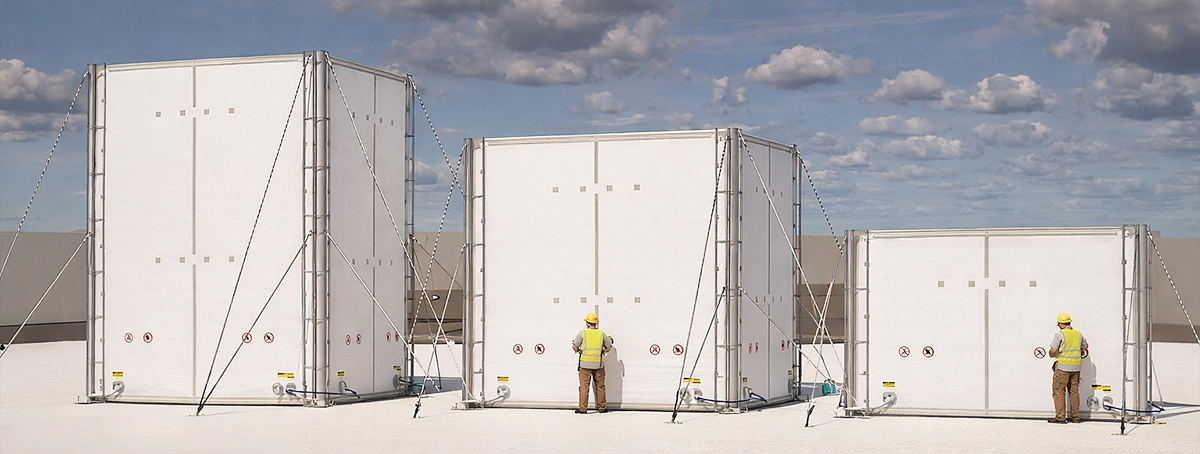
Various screen heights are possible for mobile applications.
The chosen height determines both the acoustic effect and the structural load.
Screen height approximately 3 metres
- suitable for use in conditions of limited wind load
- suitable for many temporary situations
- relatively light construction and anchoring
Screen height approximately 5 metres
- greater noise reduction through additional shielding
- greater wind load
- heavier structural provisions required
Screen height approximately 7 metres
- applied in cases of high noise requirements
- significant wind load
- construction and anchoring always checked on a project-by-project basis
Wind load and stability
Mobile noise barriers are exposed to wind loads.
The structure is designed to withstand these loads by:
- choice of screen height
- distance between support points
- type and depth of anchoring
- combination of mass and flexibility
For taller screens or open terrain, stability is always assessed on a project-by-project basis.
Foundation and anchoring
As these are temporary applications, permanent foundations are avoided.
Instead, temporary anchoring solutions are used.
Temporary anchoring
Depending on the situation, the following may be applied, among other things:
- ground anchors
- anchor pins
- ballast solutions
- combination of anchoring and mass
The choice depends on:
- surface
- screen height
- wind load
- duration of application
Standards and guidelines (structural)
The design principles are based on applicable standards and guidelines for temporary structures, including:
- EN 1990 – Eurocode: Basis of structural design
- EN 1993 – Eurocode 3: Steel structures
- EN 1999 – Eurocode 9: Aluminium structures
- NEN-EN 13782 / 13783 – Temporary structures
- DIN 4112 – Temporary Structures (German guideline)
These standards form the framework for calculations and checks for temporary installations.
Project-based assessment
Although standard screen heights and construction principles are available, the construction and anchoring are always tailored to the project situation.
The constructive assessment may be influenced per project by factors such as:
- location
- soil conditions
- wind area
- duration of installation
The structural safety of mobile inflatable noise barriers is an essential part of responsible design.
Read more about types and acoustic performance:
Questions?
Do you have questions or want more information? Please feel free to contact us. Call us at +31 (0)316-250830. But even easier: fill out the contact form below directly. We will contact you as soon as possible!
