


Water point for firefighting drones | Deep dip reservoir
 Contact form
 +31 (0)316-250830
 Buitink Technology
Firefighting drones fly fastest when the water stands close to the fire. In practice open water is often kilometres away, or simply absent: in the mountains, in open country, in a forest with no lake or river.
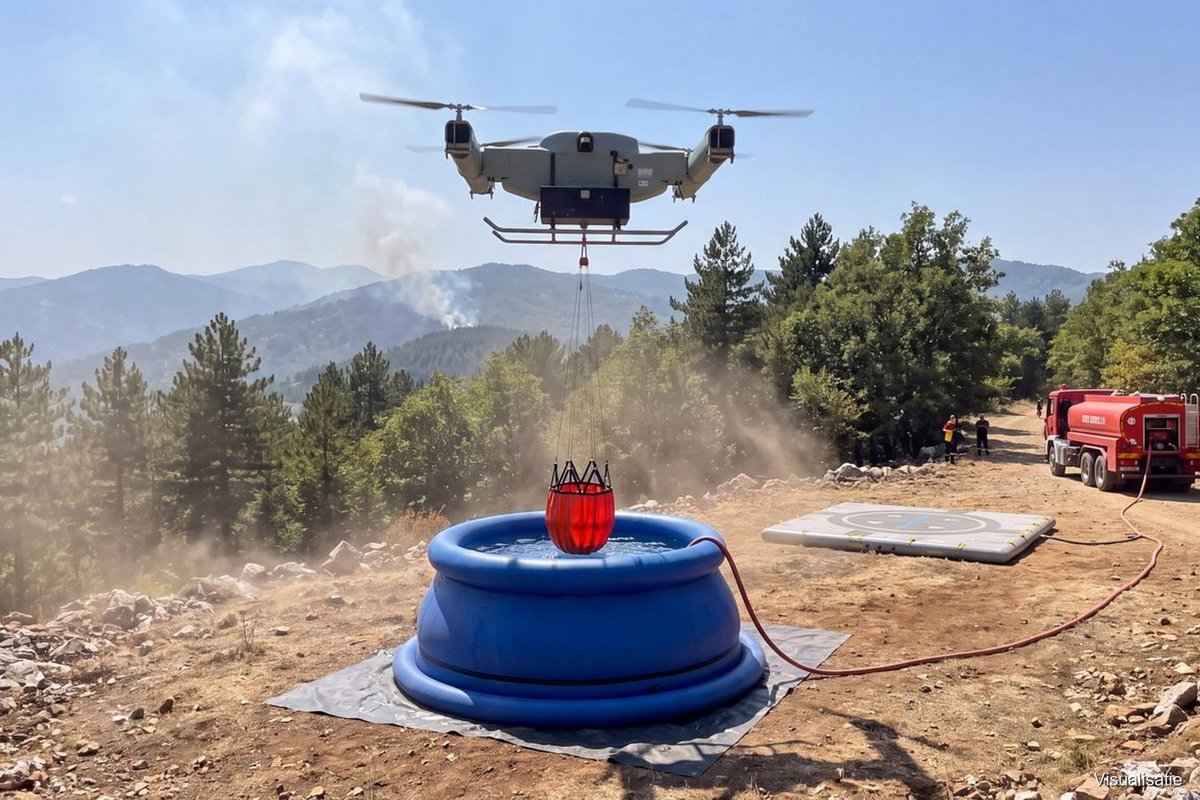
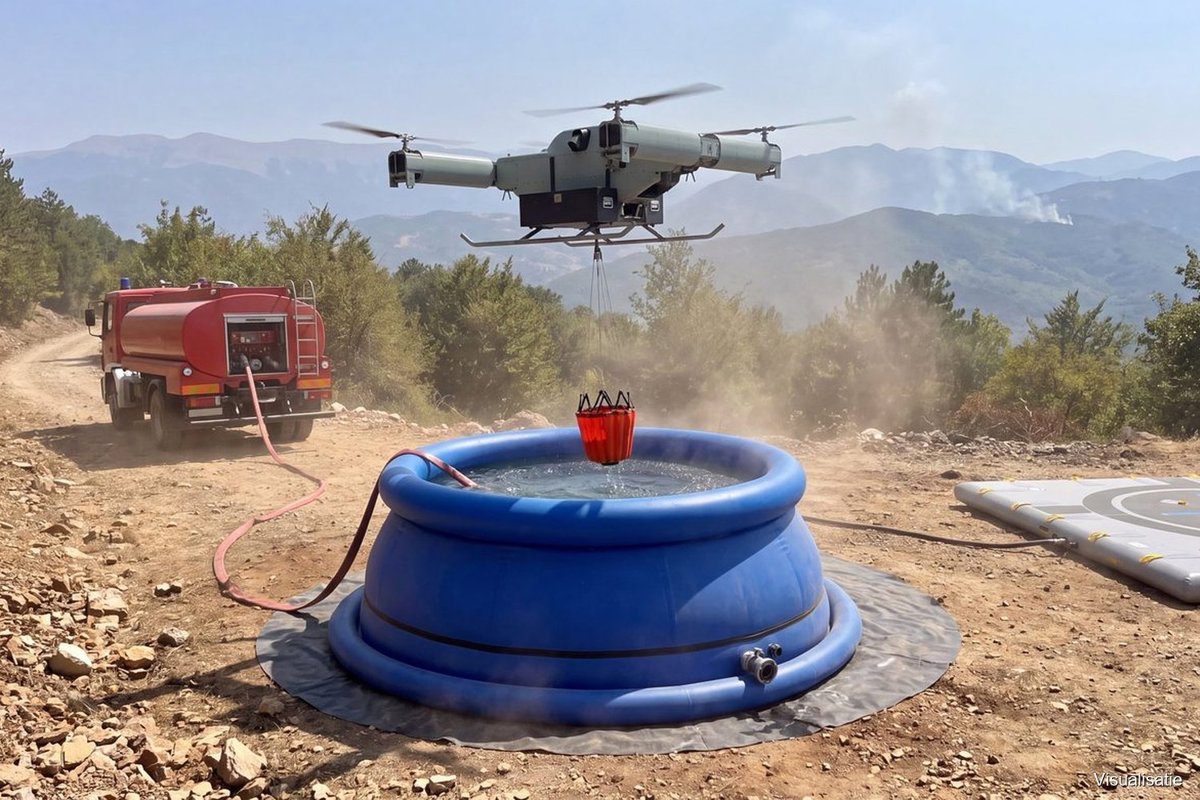
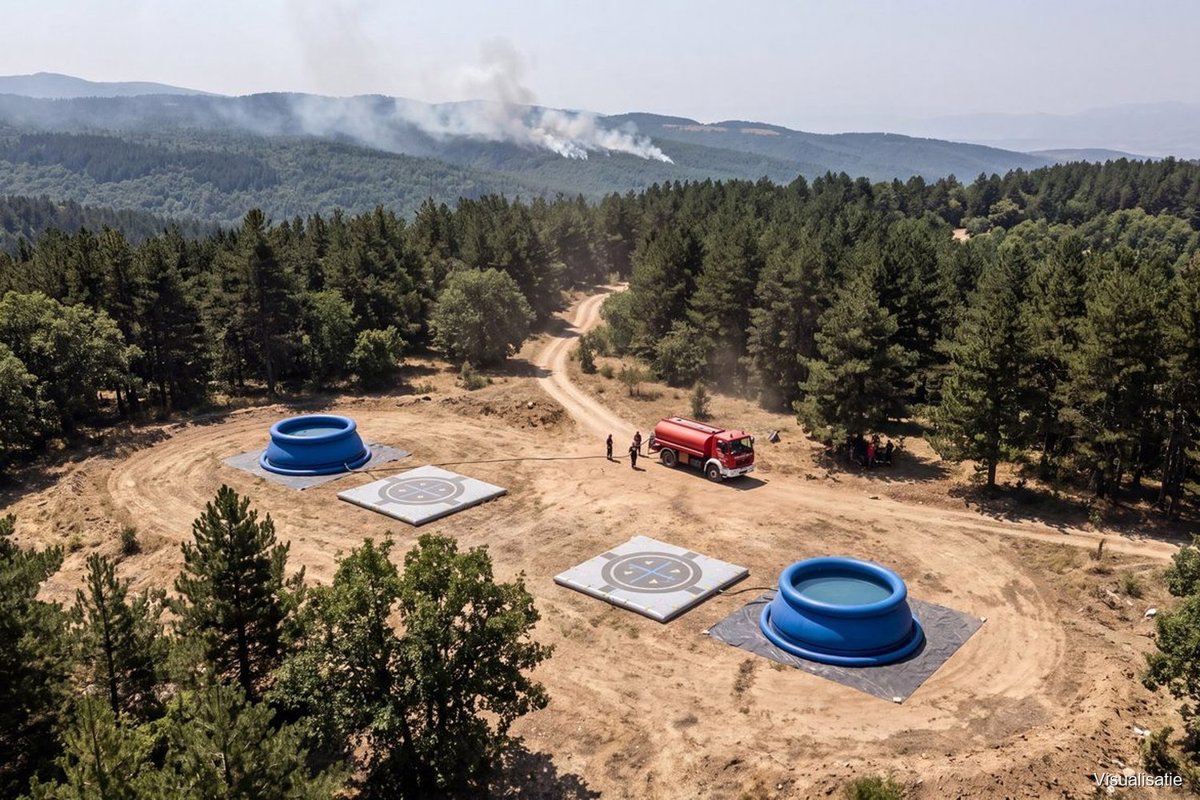
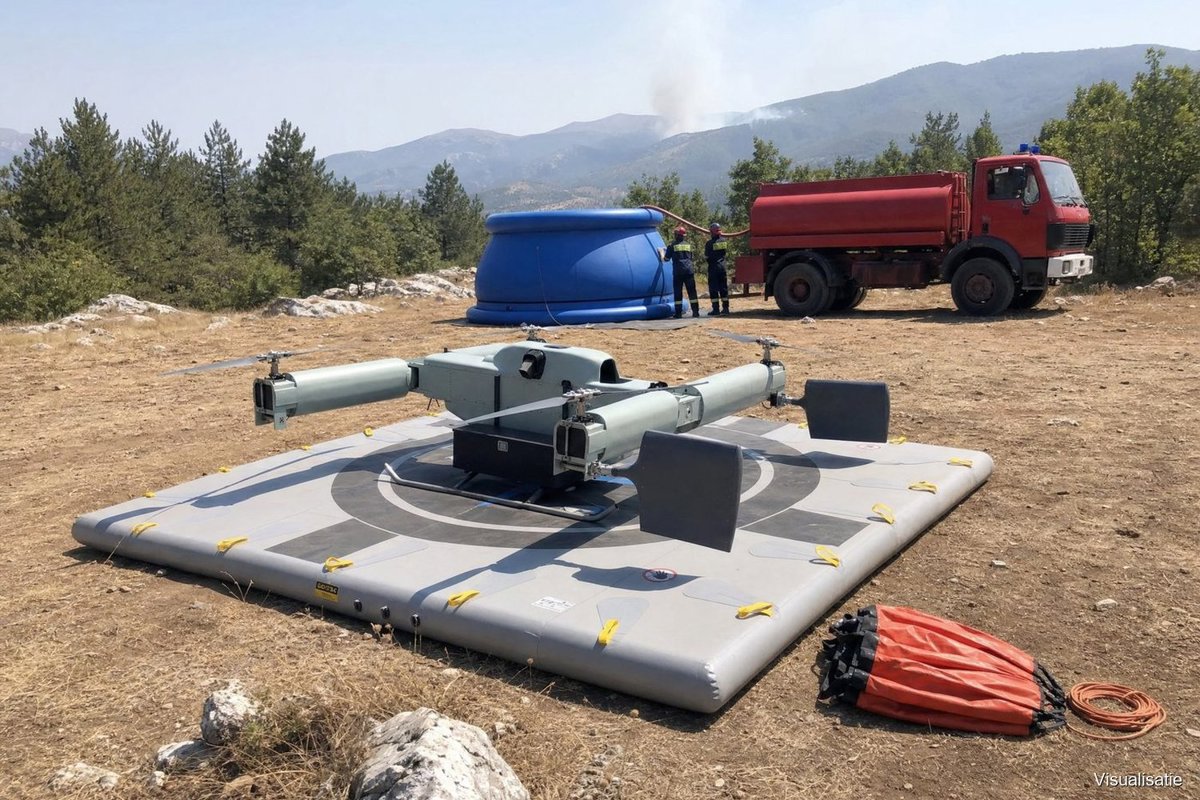
This reservoir turns any forest track into a water point. Tankers fill it, the drone dips its bucket in it and flies on. Two people set it up in a quarter of an hour, with no crane, no frame and no anchoring.
Why an ordinary basin does not work here
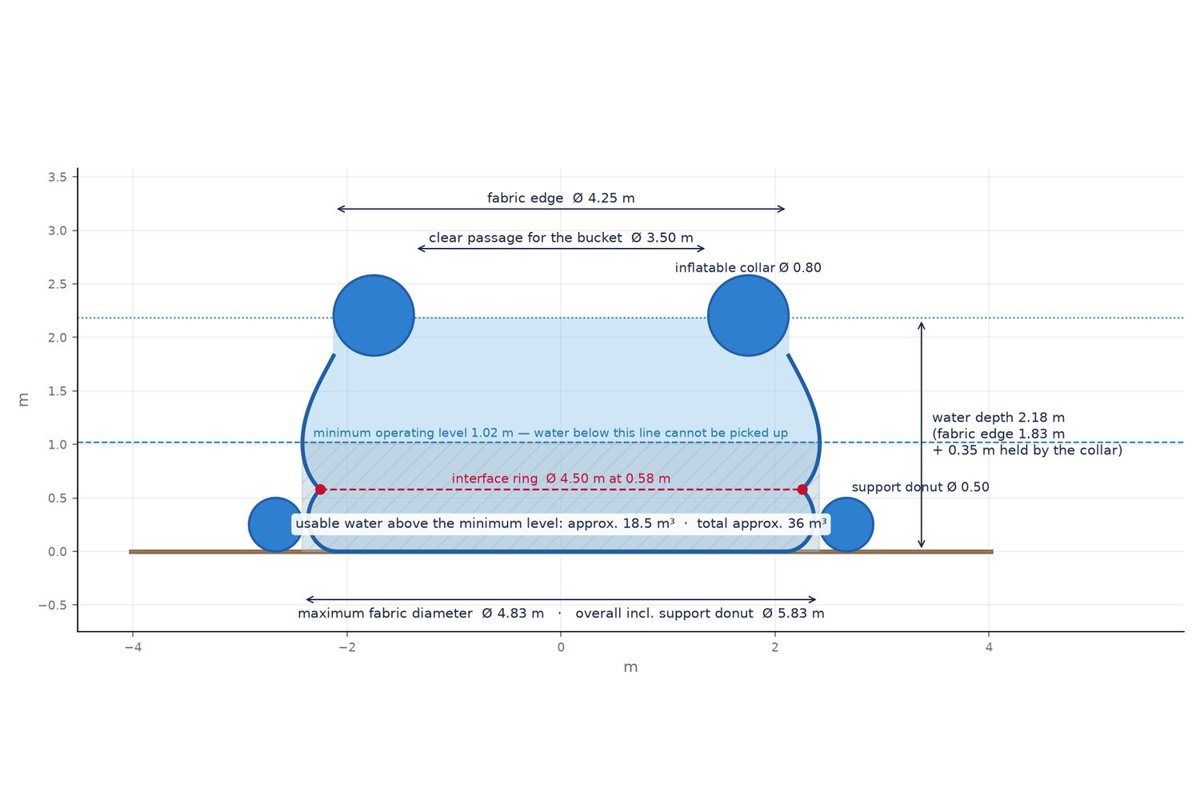
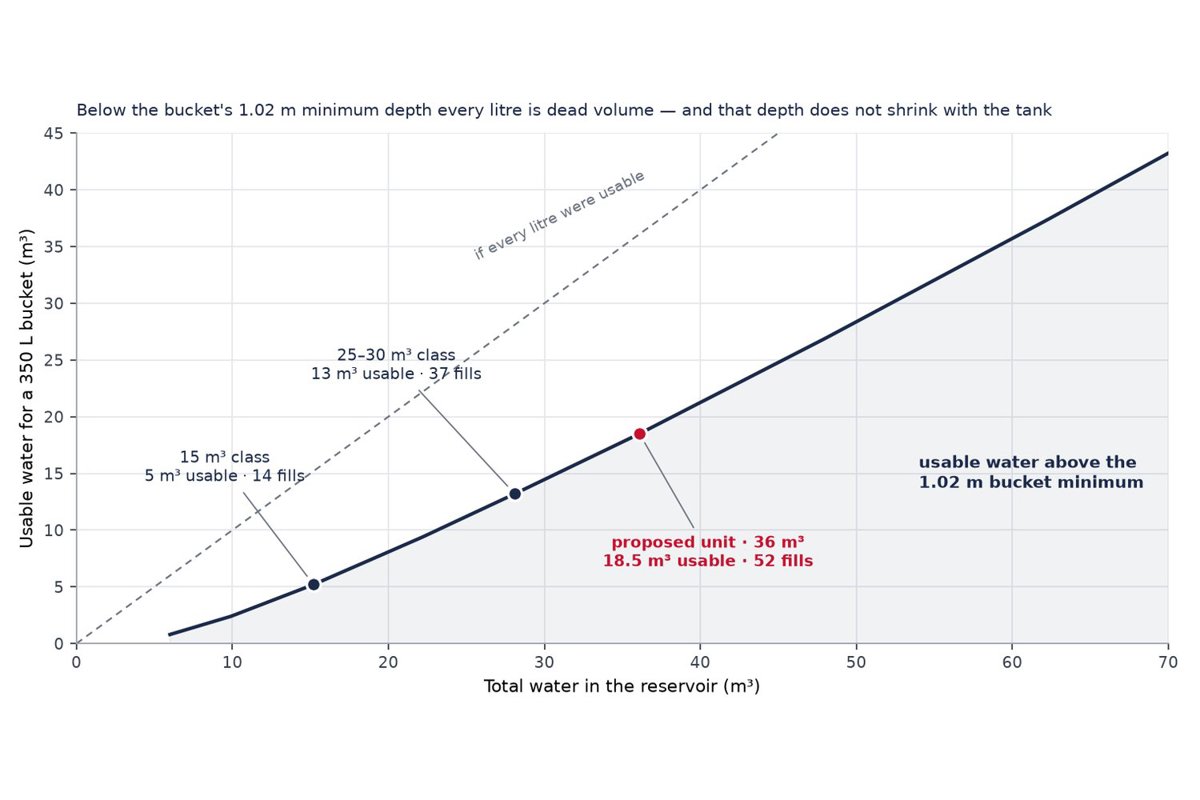
A firefighting bucket of 300 to 350 litres needs about 1.02 m of water depth to fill reliably. That figure is set by the bucket, not by the reservoir, and it does not scale down. Every litre below that level is in the tank but out of reach.
That is why a shallow basin of 12,000 to 15,000 litres is the wrong answer for this duty: it is too shallow, and what is in it cannot be taken out. A reservoir for drones has to be deep with a generous opening, not wide and flat.
If you need storage rather than a pick-up point, look at our mobile fire water reservoir.
The shape is calculated, not estimated
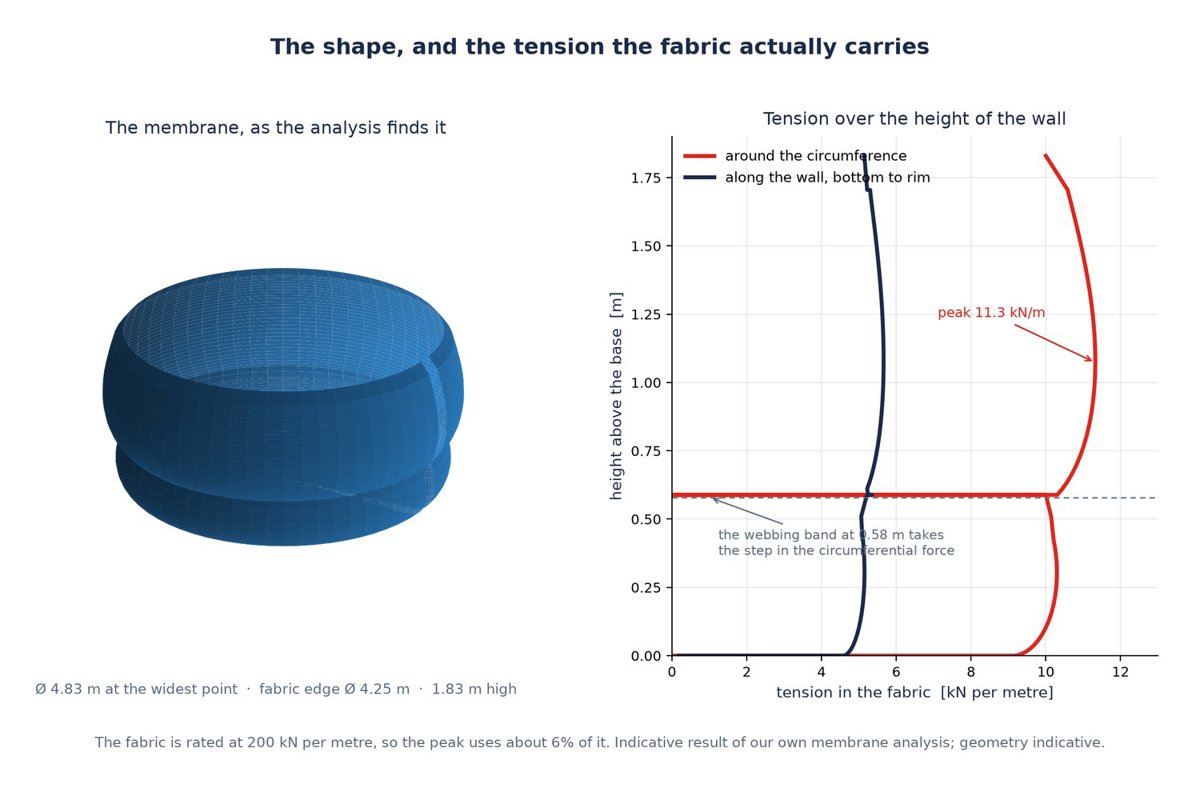
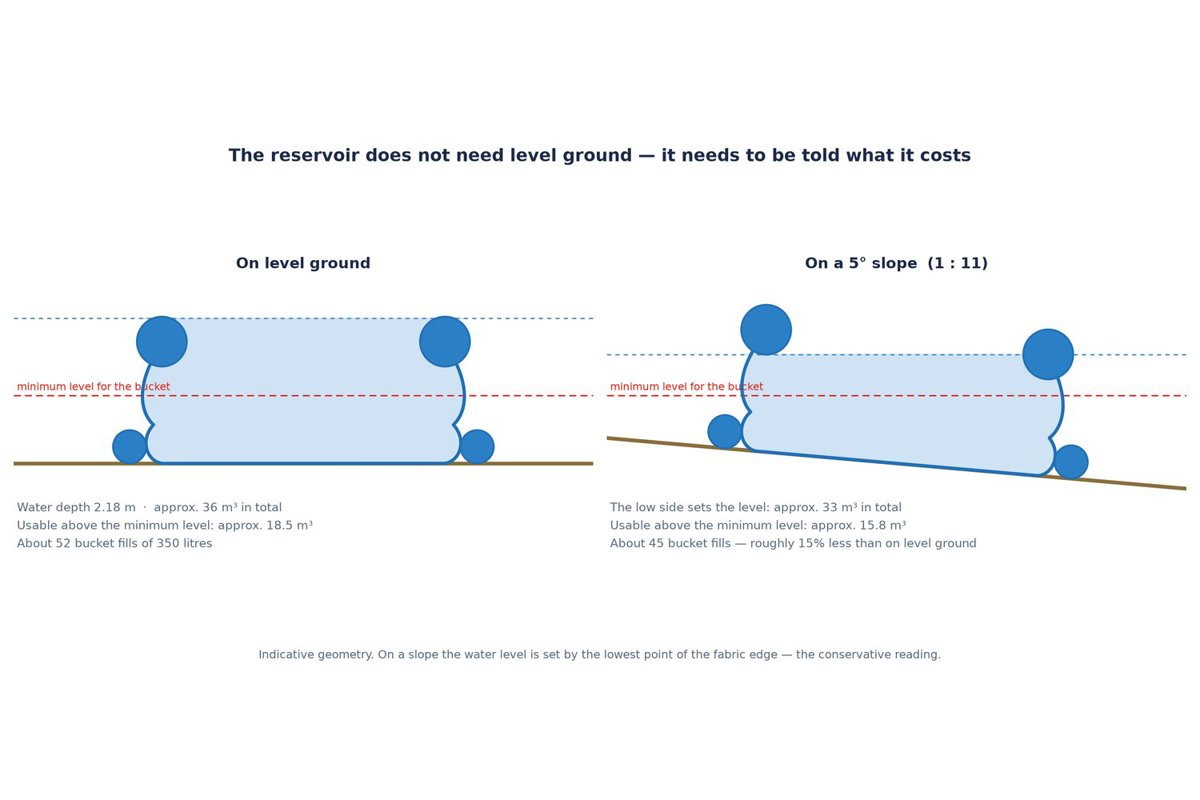
We found the shape of this reservoir with our own membrane analysis: a fabric form that, at an even tension in the fabric, carries exactly the water pressure acting on it. The result is a stacked form with a band at the transition, which holds itself in balance.
- Self-supporting. No ground anchors and no ballast. The shape stands stable by itself on level ground; a donut all round keeps the foot in place.
- An open rim with a clear passage of 3.50 m, ample for a bucket of about a metre hanging and swinging on a line.
- Fabric tension far below the limit. The peak in the wall is about 11 kN/m, against a fabric rated at 200 kN/m.
What goes in and what comes out
| Capacity | approx. 36 m³ |
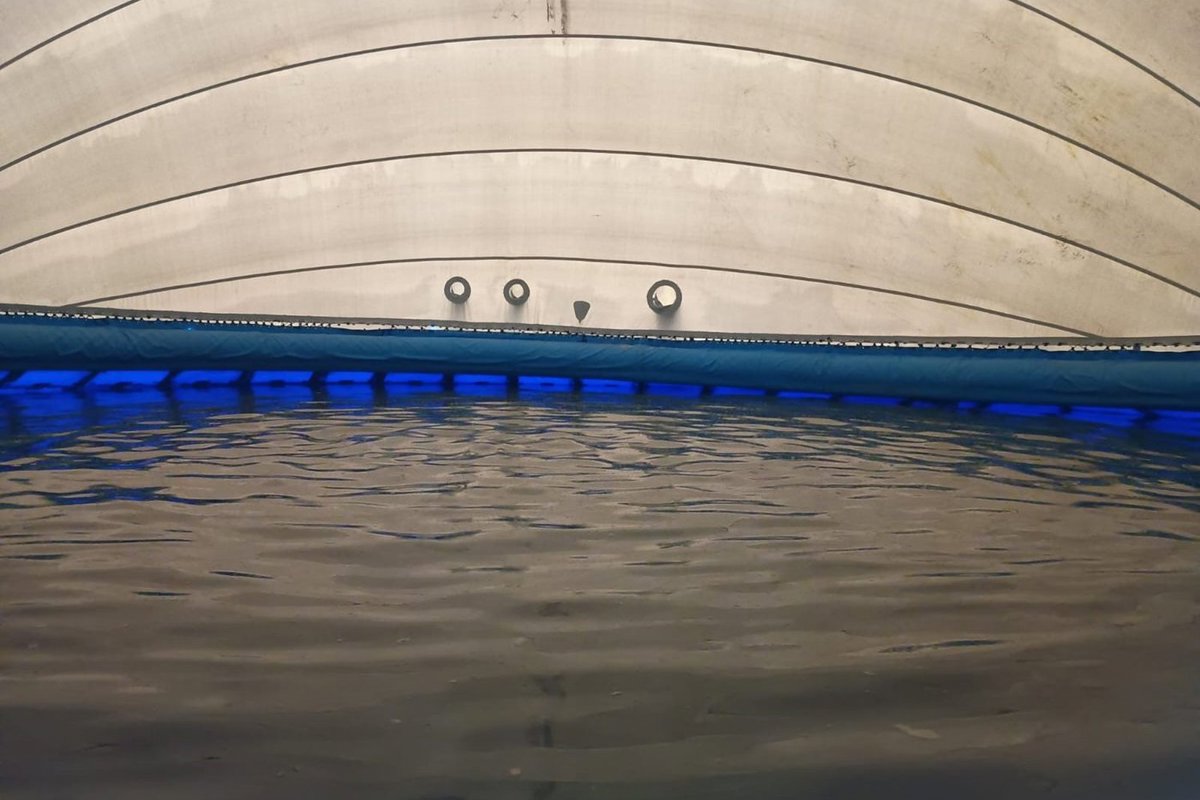
| Water depth | approx. 2.18 m |
| Clear passage for the bucket | 3.50 m |
| Largest diameter | approx. 4.83 m |
| Usable above the minimum level | approx. 18.5 m³ |
| Fills of 350 litres | approx. 52 |
| Fills of 300 litres | approx. 61 |
| Set-up | 2 people, approx. 15 minutes, 2 air pumps |
| Anchoring | none |
That usable volume is the heart of the idea: a good two hours of flying for a group of three drones with no tanker present at all. The reservoir decouples the aircraft from the road.
It does not have to be level, but it costs you something
A forest track in the mountains is rarely level. The reservoir simply works on a slope — the lowest point of the fabric rim then sets the water level. At 5 degrees (1 in 11) about 15.8 m³ remains usable instead of 18.5 m³: some 15% less. At 10 degrees it is about 30%.
We would rather say so beforehand than afterwards: it is not a limitation but an operational fact the crew leader can work with.
Filling and connections
Storz connections in the wall let the tanker couple up directly. Filling and dipping can happen at the same time: the tanker replenishes while the drone lifts its bucket out. Nothing has to be uncoupled and nobody has to stand in the water.
Water-borne extinguishing additives, such as the common class A agents at 1 to 3%, are no problem for the fabric.
Transport and set-up
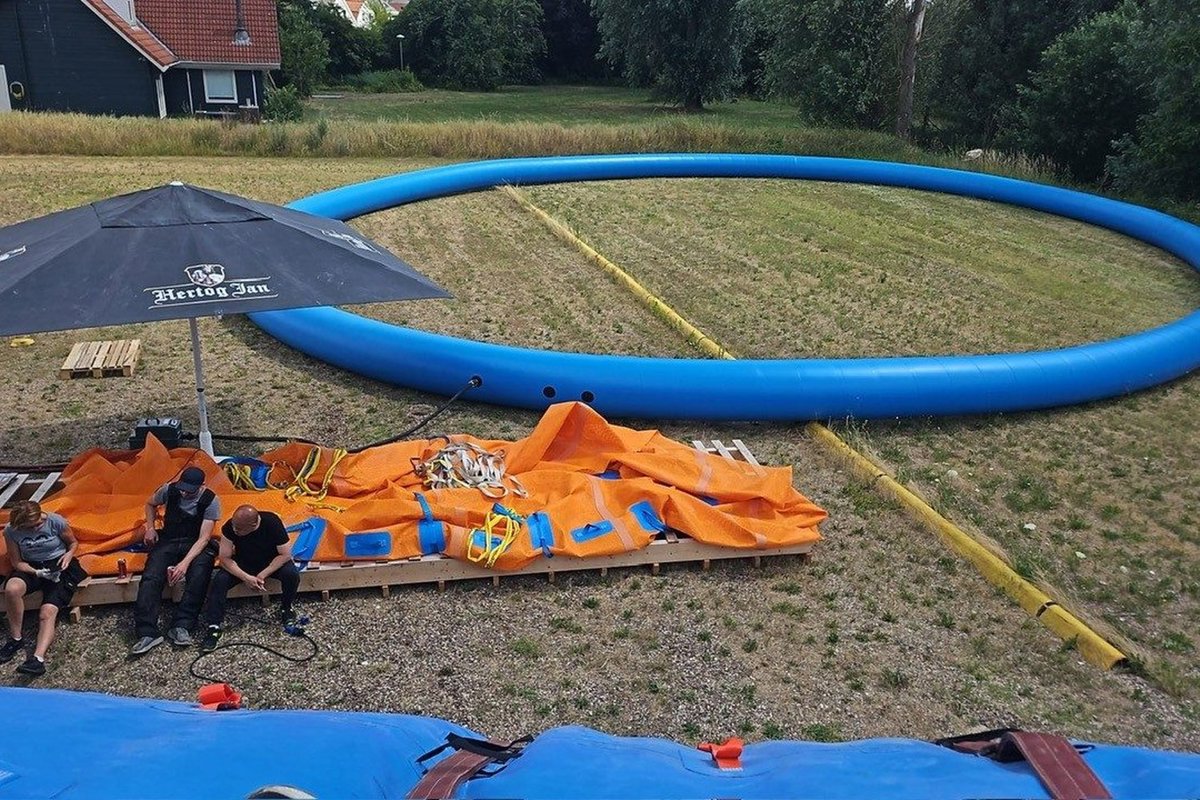
The reservoir travels folded on a pallet and is put up with two air pumps. No crane, no frame, no prepared surface: a groundsheet, the reservoir on top of it, air into the collar and the donut, and start filling.
Supplied with it: two air pumps with automatic pressure control, air hoses and couplings, Storz connections in the wall, groundsheet, transport and protection bag with lifting provisions, repair kit and deployment instructions.
A complete water point
A water point is more than the water itself. We supply the three parts that together make one installation:
- The reservoir — this page.
- The bucket — FB series, 360 to 7,600 litres, with wireless release for drones.
- The landing pad — a clean, marked place to set down between sorties, so the rotors do not draw up dust and grit.
Three drones per water point is the practical optimum: at that rate the opening is occupied about half the time and nobody has to wait in the hover.
Made to measure by default
The dimensions on this page belong to a bucket of 300 to 350 litres. If you fly a larger bucket the required depth changes and with it the whole shape — and we calculate that again. The same applies to a different opening, a larger volume or a reservoir that has to fit a particular trailer.
What we need in order to calculate: the type and capacity of the bucket, the line length at the dip, the number of aircraft per water point and how you replenish.
A water point for your firefighting drones?
Give us the bucket type, the number of aircraft and how you replenish, and we will calculate the shape and the usable volume for you.
Questions?
Do you have questions or want more information? Please feel free to contact us. Call us at +31 (0)316-250830. But even easier: fill out the contact form below directly. We will contact you as soon as possible!
