

Pipeline sinking system — custom inflatable buoyancy units
 Contact form
 +31 (0)316-250830
 Buitink Technology
How do you store 18 kilometres of steel pipeline afloat at sea — and then sink it to the seabed, section by section, in a fully controlled way? For a large offshore project in South America, Buitink Technology developed a complete floating and sinking system based on inflatable buoyancy units, commissioned by an international marine contractor.
From the first concept sketch to tested connection details: a fine piece of engineering in flexible materials.

The challenge: 1,800 tonnes of buoyancy, gone on demand
The pipeline — sections of 1,000 metres each, weighing 135 kg per metre — had to be stored afloat and towed, and then sunk at exactly the right position. That requires more than 100 kg of buoyancy per metre, some 1,800 tonnes in total. Just as important: all that buoyancy has to disappear in a controlled way at exactly the right moment, without any divers involved.
The solution: inflatable buoyancy units of 50 metres
We designed inflatable buoyancy tubes of 50 metres long and about 40 cm in diameter, made of extremely strong TPU-coated polyester fabric (tensile strength 7,400 N per 5 cm). Each unit features:
- pressure relief valves and direct air inlets;
- floating air connections, so filling and emptying is done from the water surface;
- an air system with both blowing and suction function (90 m³ per hour) for controlled inflation and deflation;
- pressure monitoring per unit;
- a release system with ropes and floats, so the units are disconnected and recovered from the surface after sinking — entirely without divers.

Two connection variants, engineered in detail
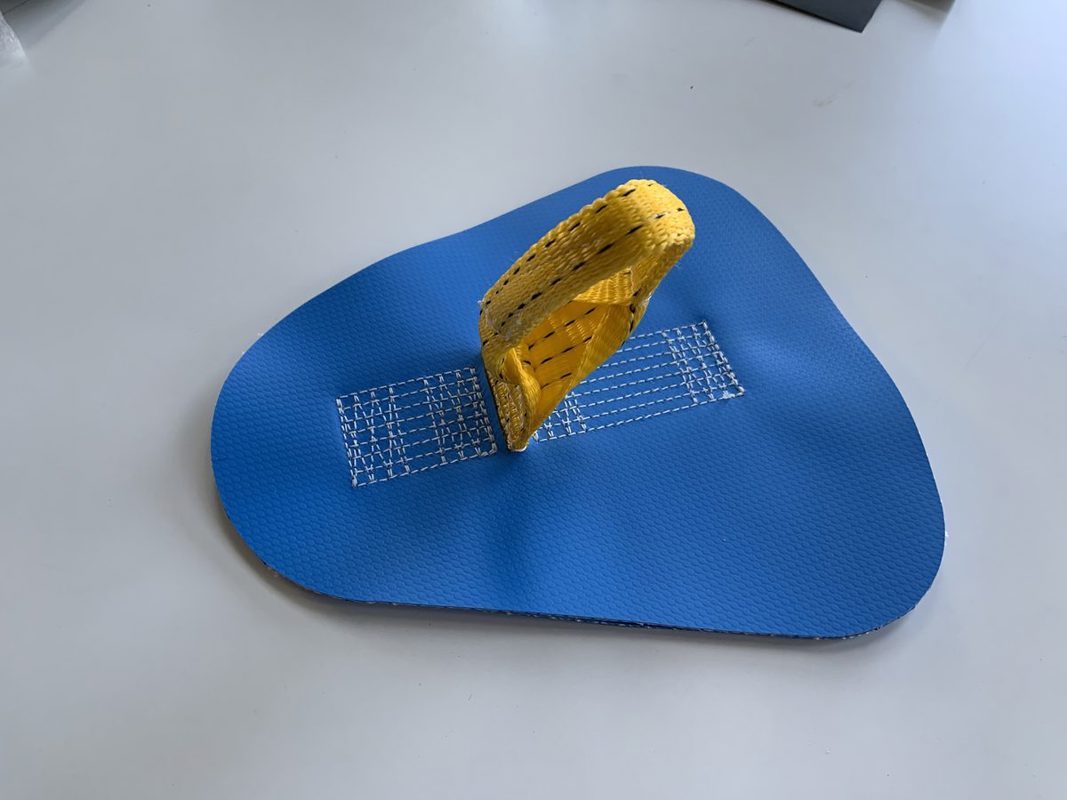
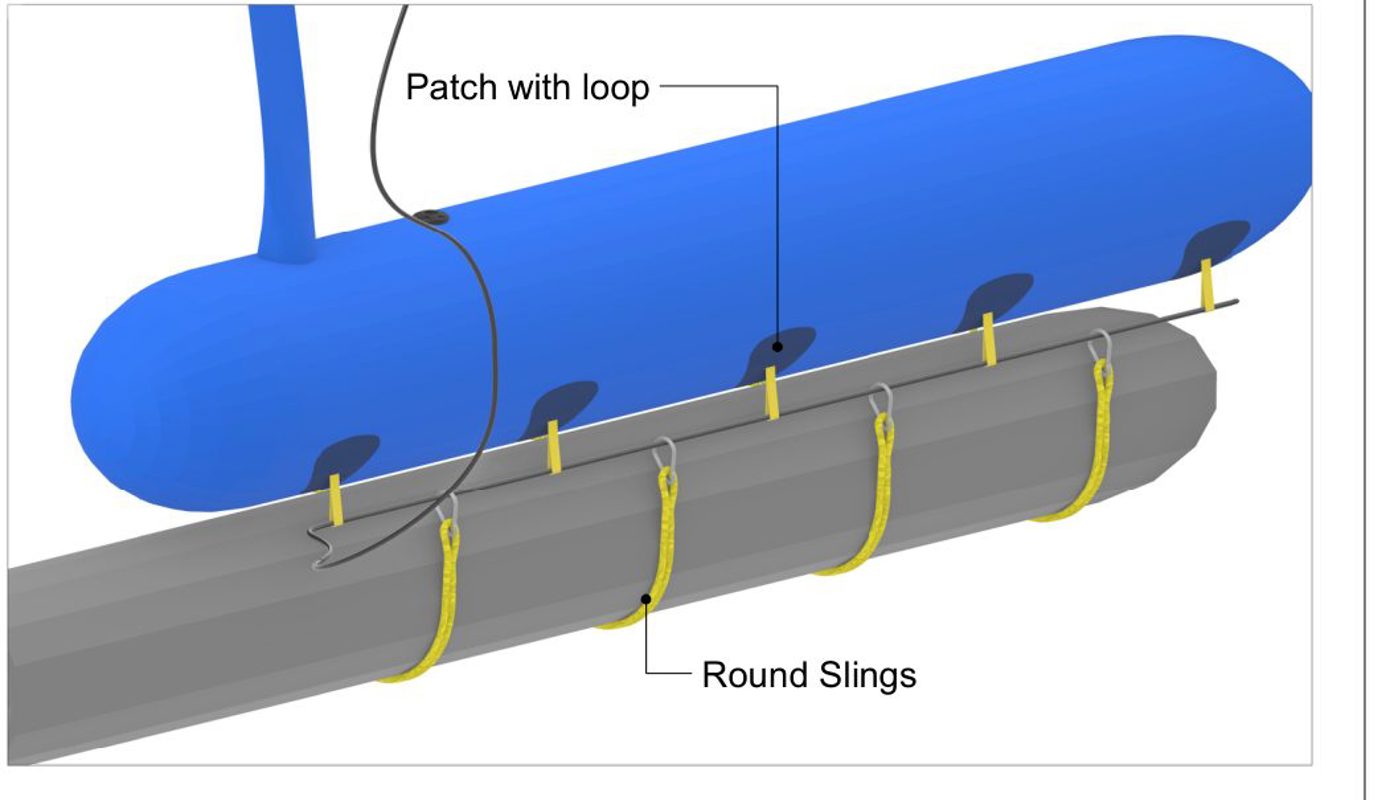
For the connection between buoyancy unit and pipeline we developed two variants. In the first, the pipe rests in a 10-metre fabric sleeve suspended from the unit with lines and snap hooks. In the second, round slings around the pipe carry the load, attached to welded patches with loops on the tube. Both variants are designed so that sleeves and slings are pulled out from under the pipe with release lines after sinking — all material is recovered and reusable.
The load introduction is all in the details: every patch is a welded reinforcement that distributes the load gradually into the fabric. We produced and tested these details in our own workshop before they went into the design.
Standard buoyancy units of 5 and 10 tonnes
This project resulted in a modular line of buoyancy units that we deploy for any floating or sinking challenge: units with 5 tonnes and 10 tonnes of buoyancy each. By combining units you build up exactly the buoyancy a pipeline, outfall or other object requires — and by deflating them in a controlled way you sink the load gently to the bottom. The units are reusable, compact to store and light enough to handle without heavy equipment. Other dimensions and buoyancy capacities are available on request.
Engineering and consultancy: from sketch to system
This project shows how we approach custom challenges. In a few weeks we went from hand sketch to fully engineered 3D design, material specification, tested connection samples and a substantiated execution plan — in close cooperation with the client's engineers. Calculating buoyancy, ballast and load introduction in flexible structures is our daily work: we apply the same knowledge to lifting bags, water barriers and pipeline floats of any size.
A buoyancy or ballast challenge of your own?
Whether it concerns sinking pipelines, lifting objects or temporary extra buoyancy on a project: we are happy to think along from the very first sketch. Contact us at [email protected] or call +31 (0)316 250 830.
Questions?
Do you have questions or want more information? Please feel free to contact us. Call us at +31 (0)316-250830. But even easier: fill out the contact form below directly. We will contact you as soon as possible!
