

Floating transport system for heavy steel marine structure
 Contact form
 +31 (0)316-250830
 Buitink Technology
For a major hydraulic engineering project in a protected nature reserve, Buitink Technology developed a comprehensive concept for the assembly, launching, floating transport and controlled sinking of a massive steel structure weighing approximately 200 tonnes.
The project combined three technical disciplines:
- Construction site protection in a sensitive area.
- Crane-free launching of heavy steel structures.
- Controlled positioning underwater.
By using a mobile floor with inflatable edge seals and custom-made floats/lifting cushions, a fully self-supporting floating transport system was created.
Technical challenge: building, launching and positioning without heavy equipment
The challenge consisted of three parts:
- The steel structure had to be erected on the riverbank within a protected nature reserve.
- There was no room for heavy cranes, pontoons or large construction equipment.
- The element had to be transported afloat and lowered in a controlled manner to its final installation position.
Conventional hydraulic engineering methods were not suitable for this project. Consequently, a completely new concept was developed based on inflatable technology and modular buoys.
Challenge 1. Site protection in a nature reserve
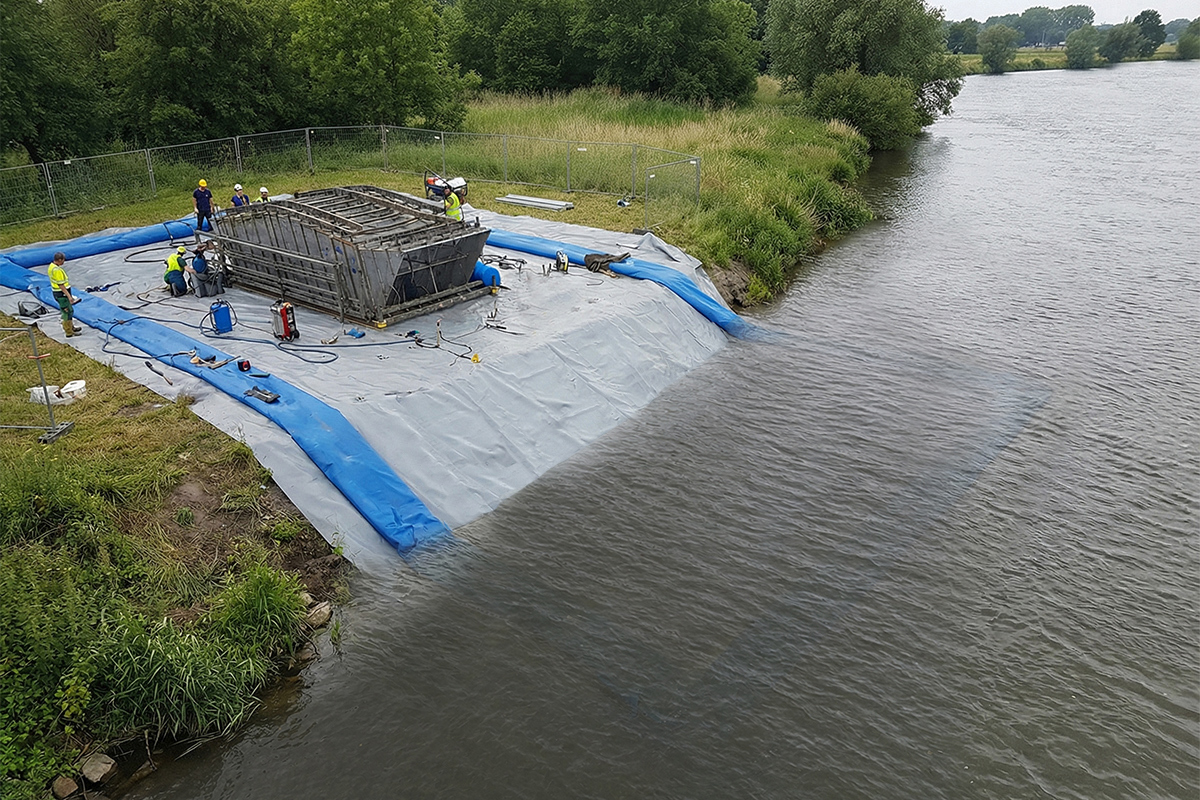
The installation took place in a riparian zone within a protected nature reserve. Strict requirements apply in such environments: grinding and welding work, flying sparks, and oil and metal residues must not enter the soil or surface water.
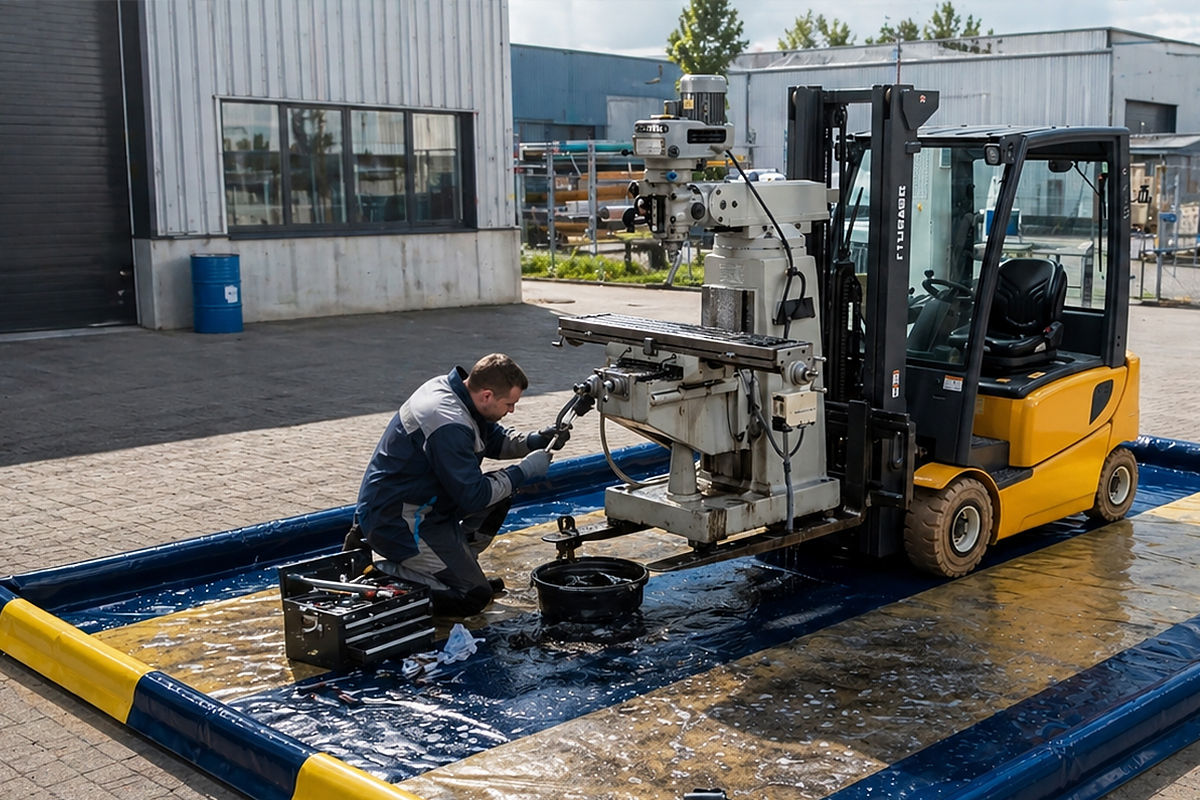
Buitink Technology installed a mobile work floor with inflatable edge seals. This technology is also used in mobile car washes and containment floors for industrial applications.
Effects of this solution:
- All dirt and construction debris is completely contained.
- The subfloor remains intact and is not subjected to mechanical stress.
- The floor can support heavy point loads from heavy steelwork.
- The work area becomes a sealed and controllable construction environment.
The mobile floor serves both as a supporting structure and as an environmental containment solution.
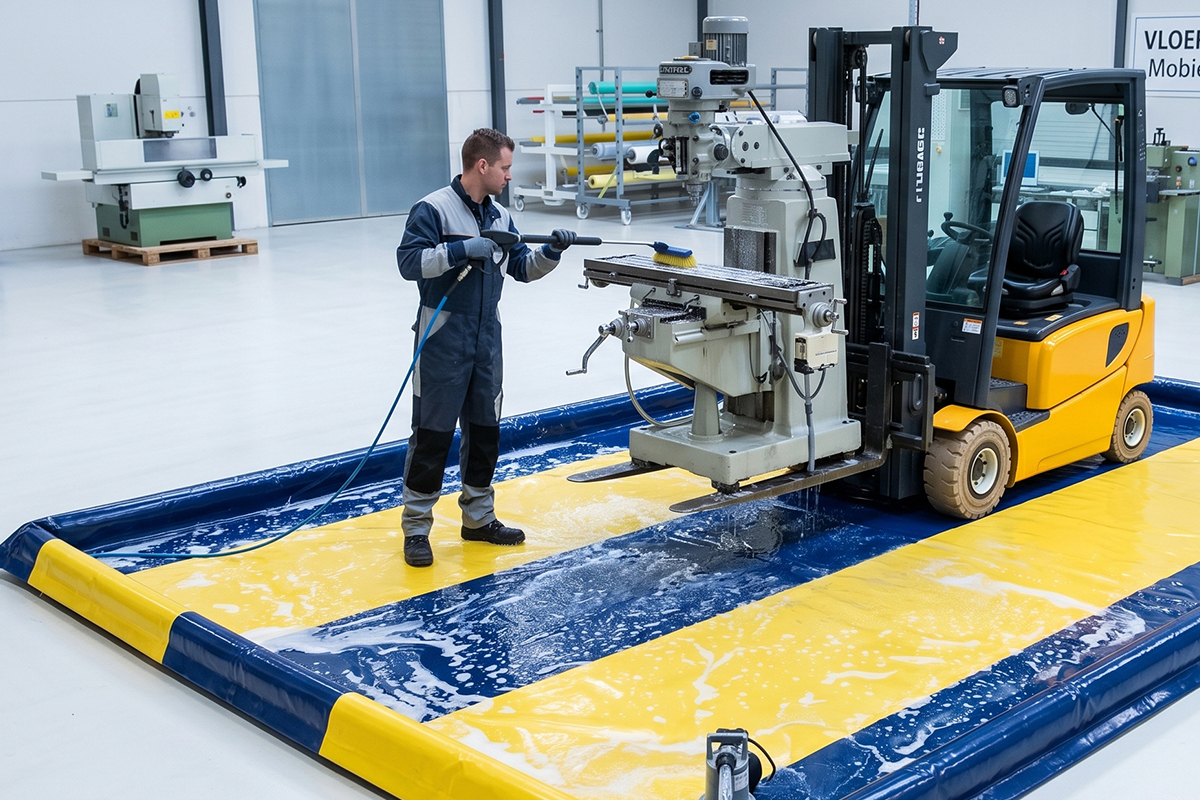
Challenge 2: Launching 200 tonnes without a crane or pontoon
Once fully assembled, the steel structure on the mobile deck was fitted with custom-made floats. These float elements were developed in accordance with the same principles that Buitink Technology applies to:
- large pontoon barges,
- salvage lifts,
- industrial lifting bags for heavy loads.
The launch procedure consisted of three steps
- The inflatable perimeter seal around the floor was inflated.
- The floor basin was filled with water in a controlled manner.
- The whole structure began to float and came away from the ground.
This enabled an object weighing approximately 200 tonnes to be launched without the use of cranes.
Challenge 3. Floating transport and controlled sinking
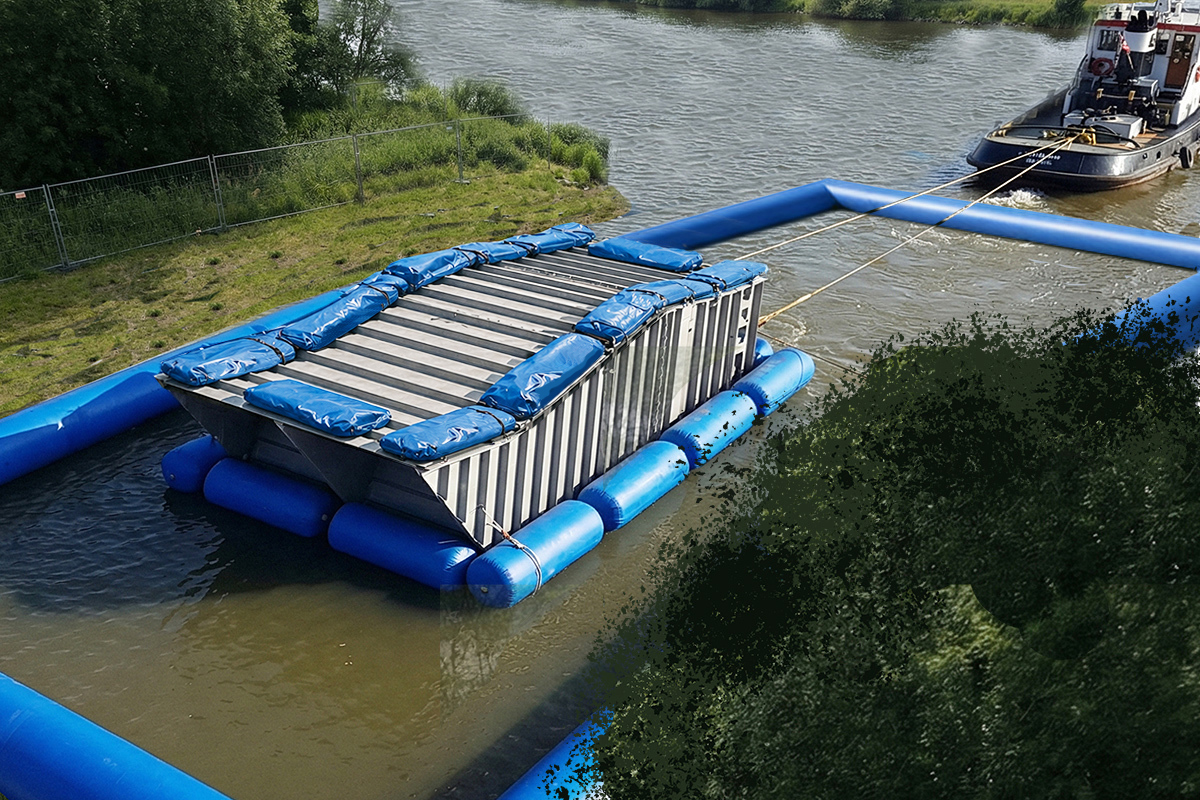
After being launched, the structure was towed across the lake to its installation position by a small tugboat. During transport, the structure was supported and stabilised by custom-made floats supplied by Buitink Technology.
What the pioneers made possible:
- Sufficient buoyancy to safely support the structure
- Stability in both longitudinal and transverse directions during towing and manoeuvring
- Fine-tuning via separate air chambers for precise trim and balance
This compartmentalisation allows for controlled ballast adjustment during both transport and installation.
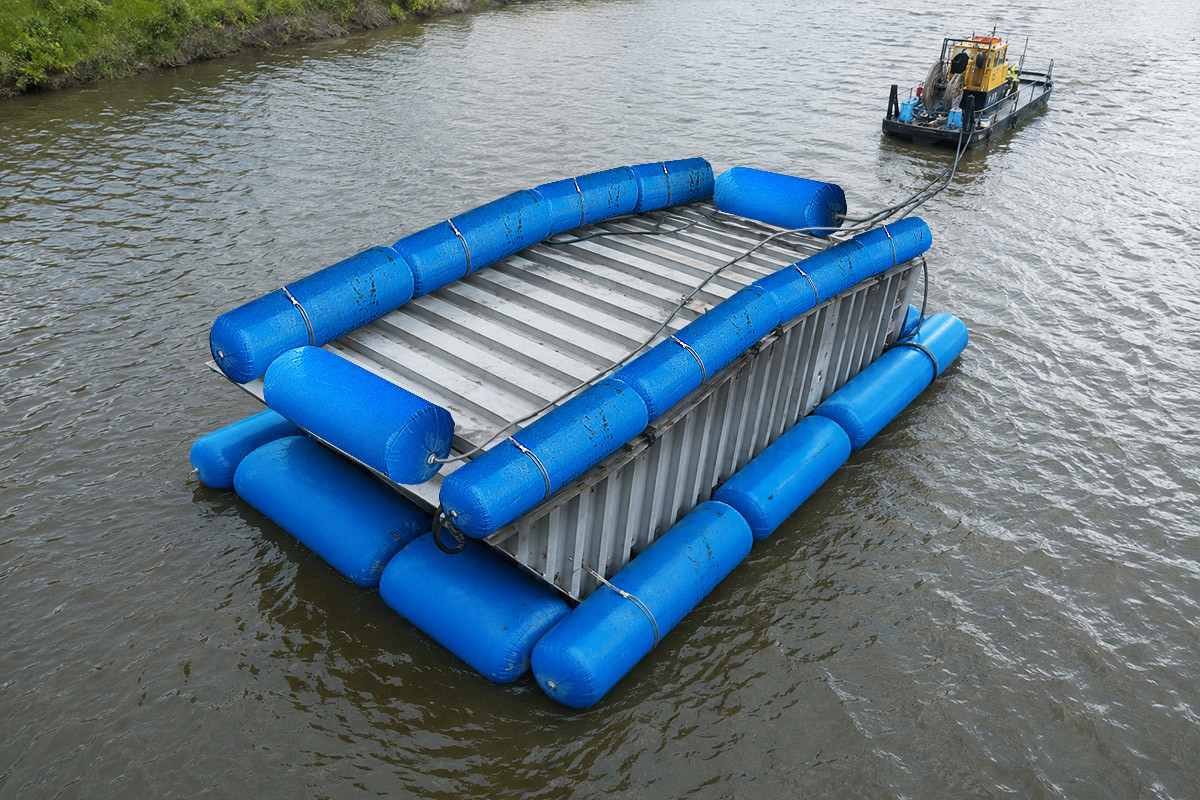
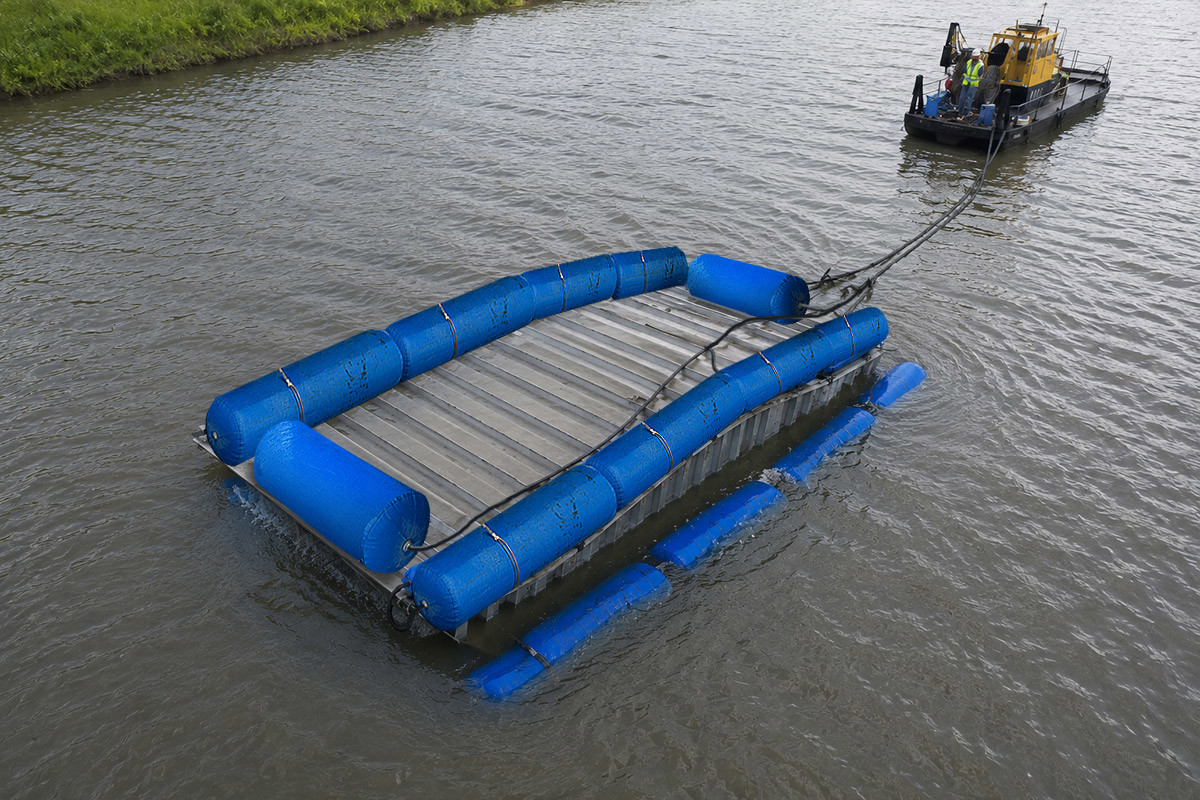
Result: a sustainable and controlled hydraulic engineering installation
Thanks to Buitink Technology’s bespoke approach, it was possible to:
- the entire steel structure can be safely erected in a nature reserve.
- the element can be launched into the water without a crane or pontoon.
- the structure can be transported over longer distances whilst afloat.
- the structure can be lowered and positioned in a controlled and precise manner.
This project demonstrates how inflatable technology can be used for complex hydraulic engineering projects, particularly in locations where conventional methods are not feasible. It also highlights the flexibility of our engineering capabilities and the scalability of floating transport systems based on custom-made floats and lifting bags.
FAQs
What is a floating transport system for heavy structures?
A floating transport system is a temporary solution that allows a large, heavy structure to be transported safely across water after being launched. Custom-made floats provide sufficient buoyancy and ensure the structure remains stable during towing, manoeuvring and positioning at the installation site.
Why are customised floats better than standard pontoons or cranes?
Custom-made floats are designed based on mass, dimensions, centre of gravity and transport conditions. This means they can often be used where pontoons or heavy cranes cannot fit or are not permitted (for example, where space is limited, ground pressure is restricted or in sensitive environments), whilst still allowing for controlled transport and installation.
How do the floats provide longitudinal and transverse stability?
Stability is achieved through the positioning of the floats around the structure, the geometry and volume of the floats, and the ability to adjust the filling on each side. This allows both lateral stability (rolling) and longitudinal stability (pitching) to be actively controlled during transport and during sinking.
What is the advantage of separate air chambers in floats?
Separate air chambers (compartmentalisation) allow for fine-tuning. You can adjust the pressure and volume in each chamber to correct trim and balance. This acts as a precise ‘ballast control’, ensuring that the object remains stable during towing and installation and can be adjusted in a controlled manner.
How does controlled immersion with floats at the installation site work?
On site, the structure is lowered in stages by carefully deflating the floats (room by room). This allows the structure to sink gradually and predictably, whilst maintaining control over its angle and position. This is particularly important when the element needs to land precisely within or on guides.
How accurate can underwater alignment be with this system?
Buoyancy control for each air chamber allows the position to be adjusted with great precision. In practice, this enables alignment to within a millimetre, even with large structures, as small adjustments to buoyancy have an immediate effect on the structure’s posture and orientation.
Is a small tug sufficient to transport such a heavy structure?
This is often the case, as the floats ‘carry’ the weight and the tugboat primarily provides the traction needed for movement. The type of tugboat required depends on drag (shape, wind, waves/current) and the desired speed/route. The system is tailored to these factors in the transport plan.
What applications is a floating conveyor system suitable for?
Typical applications include the movement and installation of heavy steel or concrete structures, modules, bridge sections, intake structures, lock or hydraulic engineering components, and parts that cannot be installed using cranes or pontoons. Also suitable when transport by water is the only logistical option.
What information is needed to properly design floats and ballast control?
Key factors include: total weight, dimensions, centre of gravity, required freeboard, lifting/attachment points, transport route (water depth, wave action, wind), installation method (guides/landing points) and the required controllability (number of air chambers/control zones). Based on these factors, buoyancy, stability and chamber layout are determined.
Questions?
Do you have questions or want more information? Please feel free to contact us. Call us at +31 (0)316-250830. But even easier: fill out the contact form below directly. We will contact you as soon as possible!
