

Underwater lift bags: independently engineered and tested
 Contact form
 +31 (0)316-250830
 Buitink Technology
An underwater lift bag looks simple, but the design is critical: the fabric must carry the working load with a generous margin, and the air inside expands rapidly during ascent. That is why our lift bags are backed by independent engineering calculations and why every bag is tested before delivery. This page explains how.
Design basis: IMCA D-016
All Buitink Technology underwater lift bags are designed and built to the same engineering principles as IMCA D-016, the international standard of the diving and offshore industry. In short: a safety factor ≥ 5:1 on the bag’s working load limit, ≥ 7:1 on the lifting slings (EN 1492-1), a unique serial number per bag, and delivery with test certificate, manual and maintenance instructions. IMCA D-016 itself covers open parachute type bags and excludes totally enclosed bags from its scope; the enclosed ranges are designed, built and inspected to the same principles.
Structural analysis of fabric and construction
An independent engineering firm performed a static strength analysis of our open parachute lift bags up to 35 tonnes. Result: the safety factor on the fabric is approximately 5 — exactly the margin IMCA D-016 requires — based on the load transfer through the welded patches.
Free-ascent behaviour, independently calculated
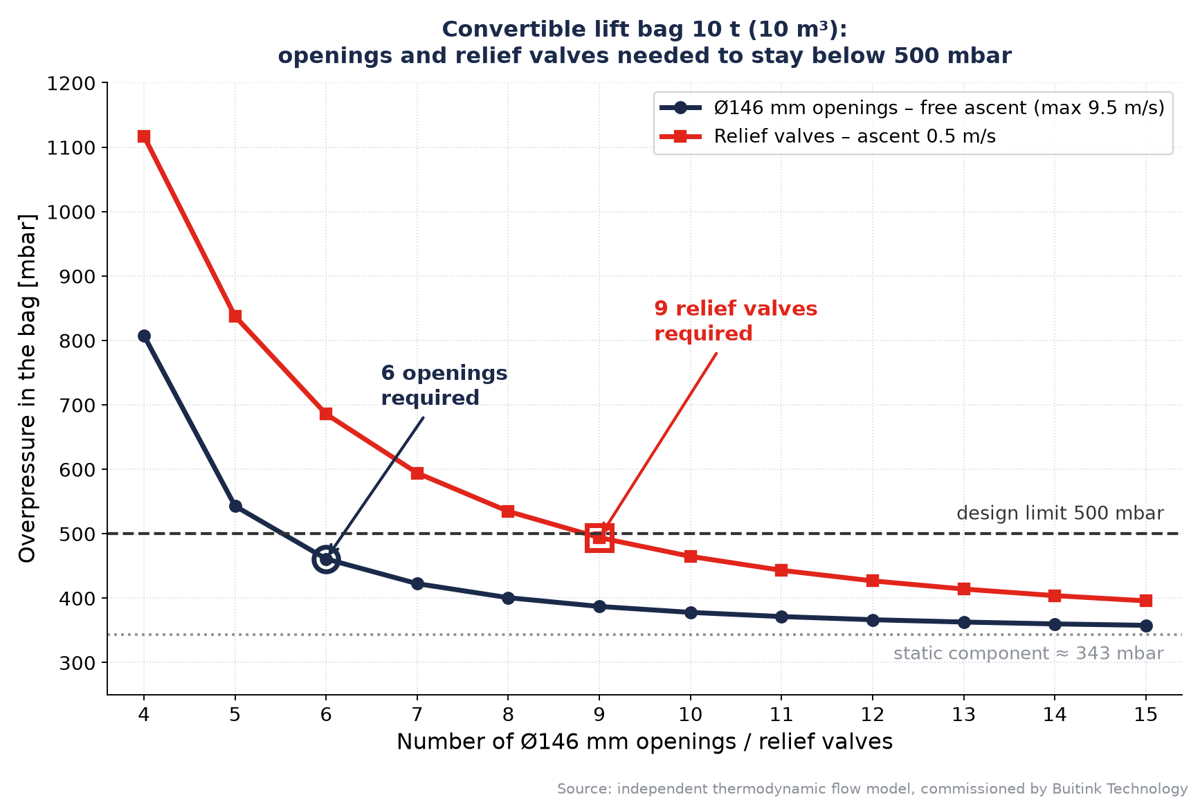
For the convertible version of our pontoons, Buitink commissioned an independent engineering firm to build a thermodynamic flow model: what happens when a 10-tonne bag ascends freely and the expanding air has to escape? The model determines, per size, how many Ø146 mm openings and how many overpressure valves are needed to keep the pressure in the bag below 500 mbar — up to an ascent speed of 9.5 m/s. The number of openings and valves on our bags follows directly from this calculation.
More openings mean lower pressure, but the bag never gets below the static component (±343 mbar) — the chart shows why this 10-tonne bag has six openings and nine valves.
An opening and a relief valve do the same job — releasing expanding air — but they are not interchangeable: the Ø146 mm opening is permanently open and passes a large volume of air (open parachute mode), whereas a relief valve only opens above its set pressure and passes just a fraction of that flow. That is why six openings suffice during free ascent (9.5 m/s), while the closed configuration already needs nine valves at only 0.5 m/s.
For clarity: 9.5 m/s is the calculated maximum speed of this bag in free ascent — the worst case, with the load released; 0.5 m/s is the assumed speed of a normal, controlled lift.
Engineering for every order
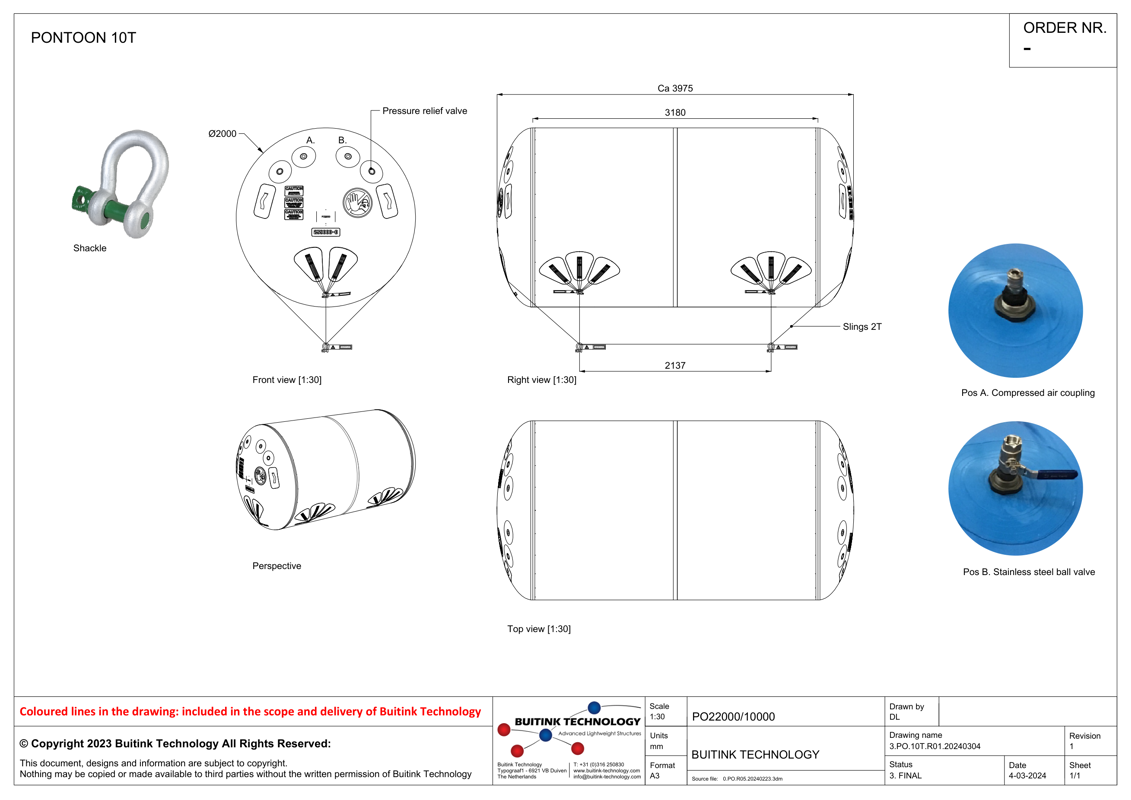
Every delivery is detailed in our own working drawings, showing all views, valve positions, slings and air connections — like this example of a 10-tonne pontoon (PO22000/10000). User and inspector know exactly what was delivered, and every bag can be traced through its serial number to drawing and test results.
Tested before dispatch
Every bag passes the same test programme before dispatch: a pressure test, a functional test of the overpressure valves and a 24-hour airtightness test. The load transfer — welded patches and handles — is proven on our own test benches (up to 300 kN). Results are recorded per serial number in the test certificate that ships with the bag.
Questions?
Do you have questions or want more information? Please feel free to contact us. Call us at +31 (0)316-250830. But even easier: fill out the contact form below directly. We will contact you as soon as possible!
